Georgia: The Freight Crossroads of the American South
Georgia is a critical logistical crossroads connecting the eastern seaboard, the Gulf Coast, and the Midwest. Over 85 percent of the US market is reachable within a two-day truck transit from Georgia, anchoring massive distribution centers along Interstate 285, Interstate 75, Interstate 85, and Interstate 20.
Meanwhile, the Port of Savannah on the Atlantic coast represents the largest single-terminal container facility in North America, generating substantial drayage volume along Interstate 16. To keep these commercial vehicles operating legally, motor carriers must comply with federal excise tax requirements under 26 U.S.C. § 4481, reported annually on Form 2290.
Using our dependable online Form 2290 e-file service eliminates postal delays and ensures immediate access to the official IRS-watermarked Schedule 1 required by the Georgia DOR.
Why Georgia DOR Mandates Stamped Schedule 1 Verification
Under federal highway statute (23 U.S.C. § 141) and Georgia Code Ann. § 40-2-26, state licensing authorities must verify proof of Heavy Vehicle Use Tax payment before issuing or renewing registration for vehicles over 55,000 lbs:
County Tag Offices
Fulton, Gwinnett, Cobb, Chatham, and all Georgia county tag offices require an IRS-watermarked Schedule 1 with an exact VIN match before issuing annual commercial license decals.
Georgia IRP Apportioned Plates
Motor carriers operating interstate under IRP must upload an official watermarked Schedule 1 to the Georgia DOR Motor Vehicle Division online portal to renew fleet cab cards.
Review how the IRS-stamped Schedule 1 serves as official legal proof of tax compliance.
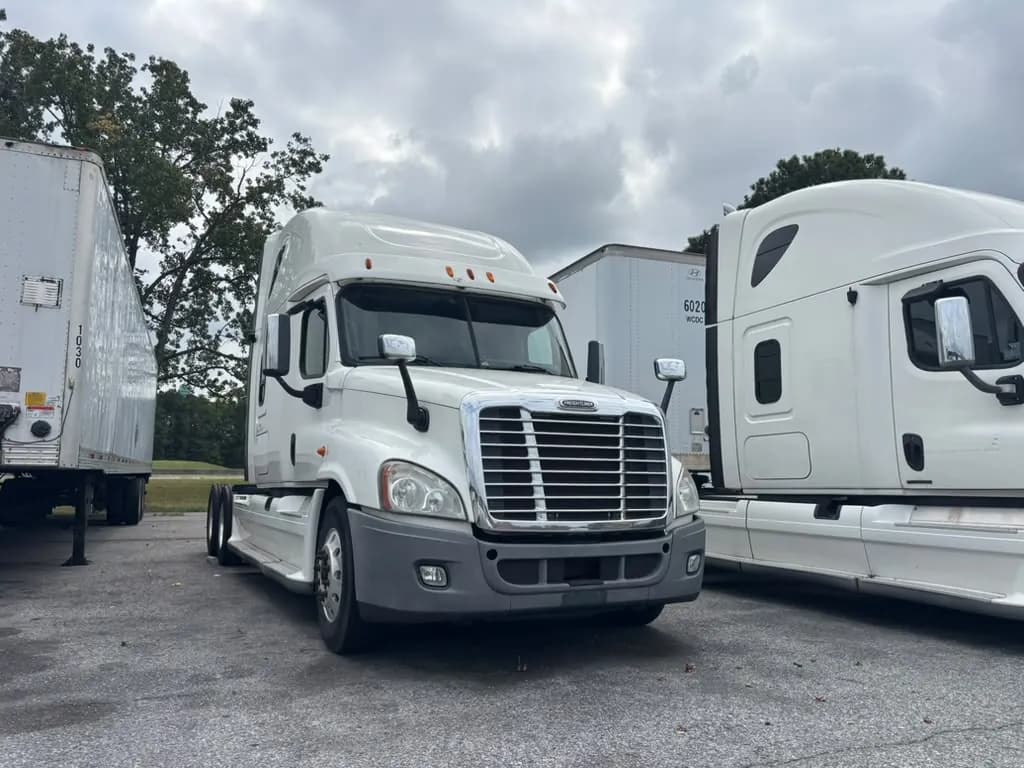
Class 8 commercial tractor operating across Georgia highway networks. Commercial power units registered at 55,000 lbs or greater must secure an IRS-stamped Schedule 1 to maintain Georgia DOR commercial registration.
2026–2027 IRS Form 2290 Tax Rate Schedule
Federal Heavy Vehicle Use Tax rates apply uniformly across all fifty states:
| Category | Taxable Gross Weight Bracket | Commercial Rate | Logging Vehicle Rate |
|---|---|---|---|
| Category A | 55,000 lbs | $100.00 | $75.00 |
| Category B | 56,000 lbs | $122.00 | $91.50 |
| Category C | 57,000 lbs | $144.00 | $108.00 |
| Category D | 58,000 lbs | $166.00 | $124.50 |
| Category E | 59,000 lbs | $188.00 | $141.00 |
| Category F | 60,000 lbs | $210.00 | $157.50 |
| Category G | 61,000 lbs | $232.00 | $174.00 |
| Category H | 62,000 lbs | $254.00 | $190.50 |
| Category I | 63,000 lbs | $276.00 | $207.00 |
| Category J | 64,000 lbs | $298.00 | $223.50 |
| Category K | 65,000 lbs | $320.00 | $240.00 |
| Category L | 66,000 lbs | $342.00 | $256.50 |
| Category M | 67,000 lbs | $364.00 | $273.00 |
| Category N | 68,000 lbs | $386.00 | $289.50 |
| Category O | 69,000 lbs | $408.00 | $306.00 |
| Category P | 70,000 lbs | $430.00 | $322.50 |
| Category Q | 71,000 lbs | $452.00 | $339.00 |
| Category R | 72,000 lbs | $474.00 | $355.50 |
| Category S | 73,000 lbs | $496.00 | $372.00 |
| Category T | 74,000 lbs | $518.00 | $388.50 |
| Category V | 75,000 lbs or more (Standard Class 8) | $550.00 | $412.50 |
| Category W | Suspended (<= 5,000 mi / 7,500 mi agri) | $0.00 | $0.00 |
Calculate your tax with our free HVUT 2290 calculator, or check your specific due date using our Form 2290 deadline checker.
Georgia Logistics Hubs: City-by-City HVUT Guide
Regional commercial transport dynamics across Georgia:
Metro Atlanta: Southeast Logistics Nexus
With I-285, I-75, I-85, and I-20 converging, Metro Atlanta is the premier distribution center of the South. Carriers in Fulton, Gwinnett, Cobb, and Clayton counties rely on instant e-filing to keep linehaul and regional delivery fleets compliant with Georgia DOR tag renewals.
Savannah: Port Container Drayage
The Port of Savannah (Garden City Terminal) handles immense container volumes. Over 10,000 intermodal drayage tractors moving along I-16 and I-95 must maintain active Form 2290 Schedule 1 records to clear terminal security and Chatham County tag office checks.
Augusta: Manufacturing & Chemical Corridors
Positioned along I-20, Augusta anchors substantial manufacturing, chemical processing, and paper freight. Richmond County motor carriers require accurate Schedule 1 verifications for regional IRP credentials.
Macon: Central Georgia Freight Junction
Located at the intersection of I-75 and I-16, Macon connects Atlanta distribution with coastal shipping lanes. Regional freight operators rely on prompt electronic filing to prevent registration lapses.
Dalton: Flooring & Industrial Freight Capital
Dalton produces the majority of America's carpet and flooring, generating heavy truck traffic along I-75 into Tennessee and the Midwest. Heavy dry van operators need fast Schedule 1 processing to keep trucks rolling.
Columbus & South Georgia Agriculture
Connecting West Georgia freight with Alabama markets, South Georgia features heavy poultry, peanut, and timber transport. Agricultural vehicles traveling 7,500 miles or less can claim Category W suspended status to receive a stamped Schedule 1 with zero tax due.
Solutions for Georgia CPAs & Trucking Tax Consultants
Accounting firms and transportation tax consultants across Georgia can manage client motor carriers under Consulics without an IRS EFIN. Preparers can submit returns using Paid Preparer PTIN credentials or as Third-Party Designees. If a client VIN has a typographical error, submit a free Form 2290 VIN correction to generate an updated watermarked Schedule 1 in minutes.
Explore our dedicated resources for tax professionals.
Frequently Asked Questions: Georgia Form 2290
Does the Georgia Department of Revenue require an IRS-stamped Schedule 1 for vehicle tags?
Yes. Under 23 U.S.C. § 141 and Georgia Code Ann. § 40-2-26, the Georgia Department of Revenue (DOR) Motor Vehicle Division and county tag offices strictly prohibit issuing or renewing commercial vehicle registrations or International Registration Plan (IRP) apportioned credentials for vehicles registered at 55,000 pounds or more without an official IRS-watermarked Form 2290 Schedule 1.
When is Form 2290 due for commercial trucks operating in Georgia?
The annual federal HVUT tax period runs from July 1 through June 30. For commercial vehicles in service during July, Form 2290 must be filed by August 31. For vehicles acquired or first placed in highway service during any subsequent month, the return is due by the last day of the month following the first month of use.
How much is the Heavy Vehicle Use Tax for a Georgia commercial combination?
HVUT is a uniform federal excise tax. Vehicles registered at 55,000 pounds incur a base tax of $100 plus $22 for each 1,000 pounds over 55,000 up to 75,000 pounds. Heavy vehicles registered at 75,000 pounds or more—including standard Class 8 tractor-trailers registered at 80,000 pounds—cap out at $550 per year ($412.50 for certified logging vehicles).
How does Form 2290 apply to Port of Savannah container drayage trucks?
Drayage tractors operating at the Port of Savannah Garden City and Ocean Terminals must comply with standard federal HVUT rules. Georgia DOR tag offices in Chatham County require an active stamped Schedule 1 matching the tractor VIN before issuing port license credentials or commercial tags.
Can a Georgia trucking CPA or tax consultant file Form 2290 for multiple clients?
Yes. Georgia CPAs, accounting practitioners, and motor carrier permit services can transmit returns for multiple client fleets through Consulics without needing an IRS Electronic Filing Identification Number (EFIN). Returns are transmitted directly under Consulics credentials using Paid Preparer PTIN credentials or Third-Party Designee authorization.