The Diesel Exhaust Fluid (DEF) & Aftertreatment Architecture: Why Modern Class 8 Trucks Derate
For commercial motor vehicle operators driving modern EPA-compliant Class 8 tractors, few dashboard alerts strike more dread than the amber exhaust aftertreatment light followed by an impending speed derate countdown. Under federal Environmental Protection Agency (EPA) clean air regulations, heavy-duty commercial diesel engines manufactured after 2010 are legally mandated to incorporate Selective Catalytic Reduction (SCR) aftertreatment systems. When an exhaust anomaly or DEF replenishment failure occurs, the engine control module (ECM) is federally required to initiate progressive torque and vehicle speed limitations—culminating in an immobilizing 5 MPH severe inducement limp mode.
The complete commercial diesel exhaust aftertreatment architecture operates in three synchronized stages: the Diesel Oxidation Catalyst (DOC), the Diesel Particulate Filter (DPF), and the Selective Catalytic Reduction (SCR) catalyst chamber. Exhaust gases exiting the turbocharger first encounter the DOC, which converts carbon monoxide and unburnt hydrocarbons into carbon dioxide and water while generating heat. The gas then enters the DPF, where microscopic ceramic honeycomb wall-flow channels trap physical particulate matter (soot). Finally, precisely metered Diesel Exhaust Fluid (DEF)—an aqueous solution of 32.5% high-purity synthetic urea and 67.5% deionized water conforming to ISO 22241—is atomized into the hot exhaust stream ahead of the SCR catalyst, converting noxious nitrogen oxides (NOx) into harmless atmospheric nitrogen and water vapor.
When any component in this electro-chemical chain fails—whether a fouled DEF dosing valve, a contaminated fluid reservoir, or a degraded upstream NOx sensor—the ECM flags a diagnostic trouble code (DTC) and begins an aggressive operational countdown. Motor carriers navigating interstate freight must understand the mechanical mechanics of DEF derates, active versus parked DPF regenerations, and roadside reset protocols to prevent missed delivery windows, stranded loads, and roadside enforcement violations.
- Selective Catalytic Reduction (SCR) Mandate: Mandated by EPA regulations to reduce nitrogen oxide (NOx) tailpipe emissions by over 90% across all heavy commercial diesels.
- ISO 22241 Fluid Standard: DEF must strictly maintain a 32.5% chemical urea concentration; diluted or tap-water contaminated fluid immediately triggers quality sensor derate protocols.
- Progressive Speed Inducement: Statutory ECM programming steps down engine output from mild torque reduction to a 55 MPH cruise cap, ending in a hard 5 MPH parking-lot speed restriction.
- Carrier Compliance Connection: Roadside emissions inspections frequently coincide with CVSA credential checks, where active IRS Form 2290 Stamped Schedule 1 proof must be verified alongside mechanical fitness.
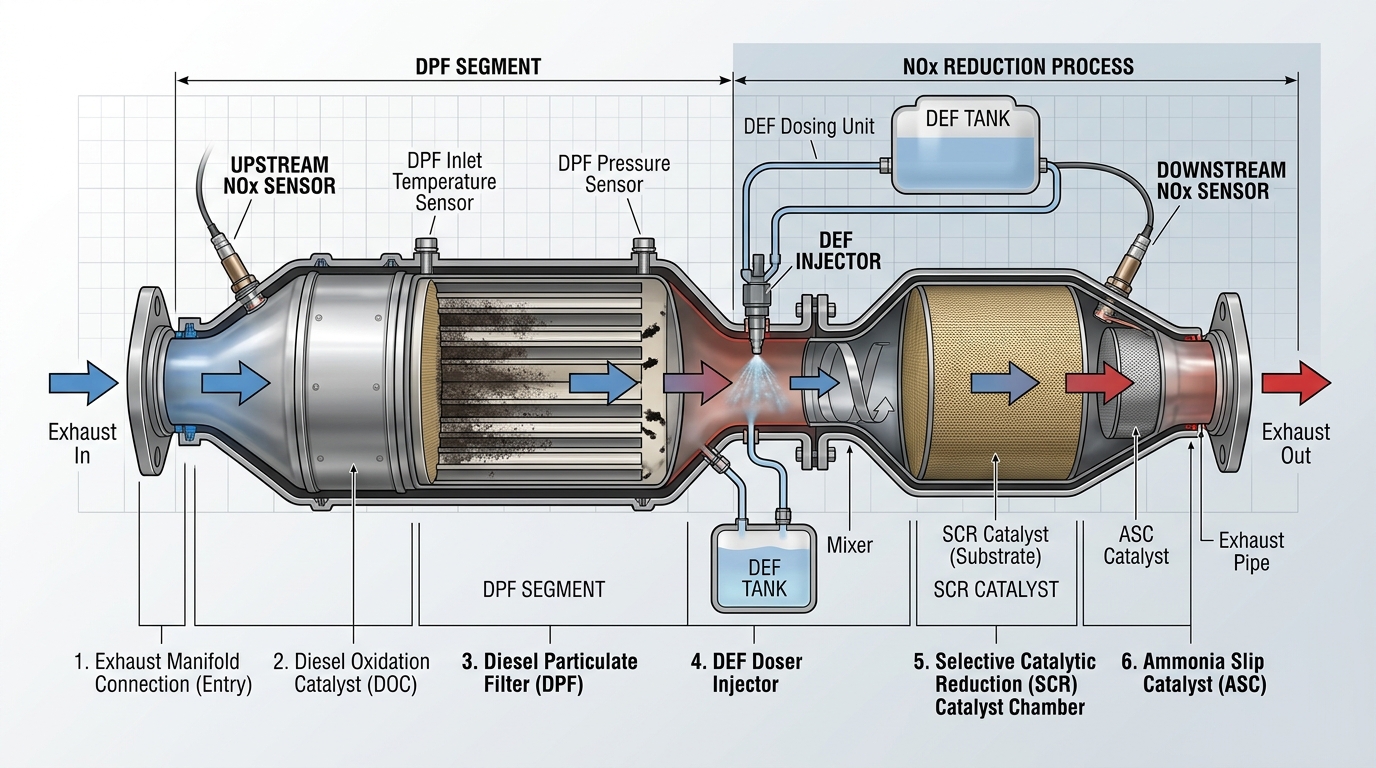
Figure 1.1: Complete commercial truck diesel aftertreatment architecture, showing DOC, DPF soot filter, DEF dosing injector, SCR catalyst substrate, and dual NOx monitoring sensors.
File Your Form HVUT 2290 to Keep Your Commercial Authority Road-Ready
Mechanical reliability keeps your truck moving on the highway, but an expired IRS tax watermark will get your authority suspended at state weigh stations. E-file Form HVUT 2290 with Consulics and secure your stamped Schedule 1 in minutes.
e-File HVUT 2290 Now →The 3 Federal Inducement Derate Stages: Understanding the Countdown Clock
Federal emissions laws strictly prevent motor carriers from operating with disabled emissions systems or dry DEF tanks. To enforce compliance, engine software implements a standardized, escalating three-stage inducement sequence. Understanding the transition points between these stages allows drivers to find safe truck stop parking or an authorized service bay before the vehicle becomes physically un-drivable on an active interstate.
The first warning stage begins when the DEF tank gauge drops below 10% capacity, or when the SCR NOx efficiency sensor detects tailpipe emissions exceeding allowable federal parts-per-million (PPM) thresholds. At this stage, a solid amber DEF dash light illuminates accompanied by an advisory chime. The truck maintains 100% engine horsepower and full road speed, giving the operator an estimated 100 to 150 miles of normal driving buffer.
If ignored, the ECM enters Stage 2: Mild Speed and Torque Derate. The amber indicator begins flashing, the "Check Engine" light illuminates, and engine software reduces available engine torque by 25% to 40%. The truck will feel sluggish climbing highway grades, and maximum governor road speed is capped at 55 MPH. If the truck is running an interstate route with high speed limits, this 55 MPH cap immediately introduces traffic safety hazards, requiring hazard flashers and immediate egress.
The final stage is Stage 3: Severe Inducement (The 5 MPH Limp Mode). This severe derate triggers under two specific conditions: either the DEF tank runs completely empty (0% fluid level), or an active emissions fault timer expires (typically after 4 hours of driving or immediately upon the next engine key cycle or fuel stop). Once active, engine output drops to idle power, limiting top speed to 5 MPH. The vehicle cannot navigate public roadways and can only creep along highway shoulders or terminal yards.
| Inducement Level | DEF Tank Level / Fault Trigger | Dash Indicator Status | Engine Output Impact | Maximum Road Speed | Immediate Driver Action Required |
|---|---|---|---|---|---|
| Warning Level | 10% – 5% DEF Fluid Capacity | Solid Amber DEF Lamp | Full Horsepower (0% Derate) | Governed Speed (65–75 MPH) | Add certified ISO 22241 DEF at next fuel stop or rest area. |
| Stage 1 Derate | 2.5% DEF or 1st Emissions Code | Flashing Amber DEF Lamp | 25% Torque Derate | Unrestricted Road Speed | Purchase DEF immediately; verify cap seal and tank heater. |
| Stage 2 Derate | 0.5% DEF or 60-Minute Grace Expired | Flashing Lamp + Solid Check Engine | 40% Torque Reduction | 55 MPH Hard Cap | Exit highway safely; avoid shutting engine down on shoulder. |
| Stage 3 (Severe) | 0% DEF Tank or Engine Key-Off Cycle | Stop Engine / Red Stop Lamp Active | 75% Torque Reduction (Limp Mode) | 5 MPH Maximum Creep Speed | Vehicle immobilized; requires DEF fill, manual regen, or diagnostic reset. |
Avoid Roadside OOS Orders with Complete Tax & Authority Proof
During roadside DOT inspections, state troopers verify vehicle maintenance alongside IRS heavy vehicle use tax compliance. Use Consulics to file Form HVUT 2290 online with instant watermarked validation.
Verify & File Form HVUT 2290 →DPF Soot Loading & Manual Parked Regeneration: Step-by-Step Procedure
While DEF issues center on chemical catalyst fluid, the Diesel Particulate Filter (DPF) creates mechanical bottlenecks when soot (unburned carbon) accumulates faster than normal highway exhaust heat can burn it off. During steady interstate hauling under heavy throttle load, the exhaust system naturally reaches temperatures between 600°F and 850°F, generating passive regeneration where soot continuously oxidizes into microscopic ash.
However, extended idling in winter weather, heavy urban stop-and-go driving, or frequent PTO operation prevents exhaust gases from reaching oxidation thresholds. Soot accumulates in the ceramic cell channels, restricting exhaust flow and increasing backpressure on the turbocharger. The DPF differential pressure sensor detects this backpressure spike and requests an active regeneration, wherein the ECM injects a secondary pulse of diesel fuel directly into the exhaust manifold to torch the filter bed to over 1,100°F.
If traffic conditions or low speeds abort multiple active regens, the dash displays the Parked DPF Regeneration Required warning icon. The operator must safely park the tractor and execute a stationary manual regeneration before the filter face plugs entirely, requiring costly off-truck thermal baking or complete core replacement.
- Step 1: Vehicle Positioning & Thermal Clearance: Park the tractor on clean concrete or asphalt away from dry grass, paper debris, trees, or combustible materials. Exhaust tip temperatures during a parked regen exceed 1,100°F (593°C).
- Step 2: Operational Interlocks: Set the tractor parking brakes firmly. Shift the automated manual or manual transmission into neutral. Chock the drive wheels if on an incline.
- Step 3: Engine Temperature Baseline: Ensure engine coolant temperature is above 150°F (65°C). The ECM will automatically reject a parked regen command if the engine is cold or idling below operating temp.
- Step 4: Foot Pedal Isolation: Remove feet completely from the accelerator, service brake, and clutch pedals. Any pedal depression immediately cancels the safety interlock sequence.
- Step 5: Initiate Dash Regen Switch: Press and hold the dash-mounted DPF Regen switch for 3 to 5 seconds. Engine RPM will automatically ramp up to high idle (between 1,100 and 1,400 RPM), the engine fan will cycle, and the exhaust tone will deepen as fuel dosing ignites the DPF core.
- Step 6: Completion & Cool-Down: The cycle takes between 25 and 45 minutes. Never shut the ignition off during an active regen cycle; allow the ECM to step down engine RPM to normal 600 RPM base idle for 3 minutes before driving.
Keep Your Fleet Operating Legally with Fast Efile HVUT 2290
Don't let administrative oversights stall your freight. File Form HVUT 2290 in 5 minutes with Consulics, receive your IRS Schedule 1 instantly, and keep your heavy haulers fully legal.
File HVUT 2290 in 5 Minutes →Top Emissions Diagnostic Trouble Codes (DTCs) & Roadside Reset Realities
When an emissions warning triggers, commercial diagnostic scanners communicate through the J1939 CAN bus network using Suspect Parameter Numbers (SPN) and Failure Mode Identifiers (FMI). While generic automotive code readers fail on heavy-duty diesel protocols, understanding the core J1939 fault patterns allows drivers and fleet dispatchers to distinguish a simple sensor glitch from a catastrophic failure requiring mobile roadside service.
A pervasive myth among highway operators is that a speed derate can be permanently bypassed by disconnecting the tractor batteries for 30 minutes or clearing fault codes with an inexpensive handheld tool. Federal EPA anti-tampering regulations mandate that all emissions inducement codes (specifically SPN 5246) be stored in non-volatile permanent memory. Simply clearing the code without completing a certified drive cycle verification will cause the ECM to re-assert the derate within 5 to 15 miles.
Below are the most frequent heavy-duty diesel emissions DTCs encountered across Detroit DD15, Cummins X15, PACCAR MX, and Volvo D13 platforms, along with root mechanical causes and pass/fail diagnostic actions.
| SPN Code | FMI Code | Fault Description | Root Mechanical / Electrical Cause | Derate Impact | Field Diagnostic Remedy |
|---|---|---|---|---|---|
| SPN 5246 | FMI 0 or 15 | Regulatory Aftertreatment Inducement Severity | Emissions fault unresolved; maximum warning grace timer expired. | Immediate 5 MPH Severe Derate | Must fix primary underlying fault, refill DEF, and run successful highway drive cycle. |
| SPN 4364 | FMI 18 | SCR Catalyst Conversion Efficiency Low | Degraded DEF fluid quality, crystal buildup on doser, or contaminated fluid. | Stage 1 or 2 Derate within 50 miles | Test DEF with refractometer (must read 32.5%); flush tank and refill with fresh certified fluid. |
| SPN 3364 | FMI 2 | DEF Tank Fluid Quality Sensor Erroneous | Ultrasonic DEF quality sensor failure or tank debris coating sensor. | Torque derate + 55 MPH cruise cap | Inspect DEF tank header wiring harness; replace ultrasonic sensor head if open circuit. |
| SPN 3226 | FMI 9 or 13 | Downstream Outlet NOx Sensor Communication Lost | Exhaust heat degradation, wiring harness pinch, or internal sensor failure. | Stage 2 Derate within 100 miles | Inspect connector pins for corrosion; replace downstream NOx probe and calibrate via diagnostic tool. |
| SPN 3936 | FMI 0 | DPF Differential Pressure Exceeded High Limit | Severe DPF soot face plugging or failed backpressure sensor delta tube. | Parked Regen Locked / 40% Derate | Check steel sensing tubes for ice or soot clogs; perform forced parked regen or off-truck cleaning. |
Need Form 2290 Stamped Schedule 1 for DMV Registration or Audit?
State DMV offices and CVSA inspectors verify HVUT tax compliance before granting credential renewals. Consulics generates your stamped proof with authentic IRS watermarks in minutes.
Get Stamped Schedule 1 Proof →Winter DEF Freezing, Tank Heaters & Anti-Crystallization Protocols
Diesel Exhaust Fluid freezes at 12°F (-11°C). Because commercial trucks frequently operate in sub-zero climates across the Northern Plains, the Rocky Mountains, and interstate corridors like I-90 and I-94, commercial truck manufacturers equip DEF storage tanks and fluid delivery lines with specialized engine coolant heating loops and electric heating elements.
When parking a commercial truck in extreme sub-zero conditions (-10°F to -30°F), the DEF tank will freeze solid into a slushy crystalline mass. This is anticipated by engine designers: ISO 22241 DEF expands by approximately 7% upon freezing (similar to water), which is why DEF tank reservoirs are molded with specialized expansion bladders and must never be filled to 100% brim capacity in winter.
Upon engine startup, the ECM activates coolant solenoid valves that circulate hot 180°F engine coolant through the tank heating coil. Federal regulations grant a 45-minute thaw grace period during which all DEF derate timers are suspended while fluid is liquefied. However, if the tank heating element burns out, the internal temperature thermistor fails, or an operator adds aftermarket anti-freeze additives into the DEF tank, severe system destruction occurs.
- NEVER Add Anti-Freeze to DEF: Adding ethylene glycol, alcohol, or windshield washer fluid to a DEF tank destroys the SCR catalyst substrate instantly, causing $12,000+ in replacement damages.
- Leave 10% Expansion Volume: In sub-zero weather, fill DEF tanks only to the 90% mark to accommodate volumetric ice expansion and prevent plastic tank seam rupture.
- Inspect Tank Drain Lines: Ensure electrical line-heating wraps surrounding the nylon DEF pressure delivery line from the tank to the doser have intact wiring harnesses without ice road-salt corrosion.
- Clean Crystallized Doser Necks: White urea crusting around the fill neck or doser flange can be safely dissolved using warm distilled water; never use chemical solvents.
Choose the Best HVUT 2290 Provider for Fast, Hassle-Free Filing
Consulics is built specifically for commercial motor carriers and owner-operators who need speed, accuracy, and IRS-authorized e-filing reliability. Keep your heavy vehicles legal on every interstate.
File Form HVUT 2290 with Consulics →Related resources
- File Form 2290 online
- How to file Form 2290, step by step
- HVUT and the stamped Schedule 1, explained
- Estimate your tax with the HVUT 2290 calculator
- Check your Form 2290 due date
- Semi-Truck Preventative Maintenance (PM A-D) Schedule
- Commercial Truck Brands, Models & Engines Guide
- DOT & OSHA Truck Safety Kit & Roadside Tools Guide
- Commercial Truck Emergency Safety Kit Requirements
- E-File IRS Form 2290 Online
- IRS Stamped Schedule 1 Proof of Payment
- Form 2290 Due Date & Penalty Calculator
- DOT New Entrant Safety Audit Preparation Guide
More Form 2290 and HVUT guides
- e-File Form 2290 Online and Get Your Stamped Schedule 1 in Minutes
- The Complete Guide to HVUT Form 2290: How to File Online, Calculate Tax, and Secure Your Stamped Schedule 1
- Why Is Your Form 2290 Schedule 1 Delayed? 6 Root Causes and How to Get Your Stamped Proof Instantly
- Commercial Truck Brands, Models & Engines Guide: Specifications, Horsepower, Torque, and Heavy Haul Ratings
- The Best IRS Approved 2290 E-File Provider: Speed, Pricing, and Features Compared
- Trusted E-File Provider IRS Form 2290: Why Truckers & Fleets Rely on Consulics
Ready to file your Form 2290?
IRS-authorized e-filing — get your stamped Schedule 1 in minutes.
e-File Form 2290 Now →This post is general information for motor carriers, not tax or legal advice, and government rules, systems, and fees can change at any time. Confirm anything before you rely on it with the IRS, the FMCSA, or a qualified professional. Consulics does not guarantee its accuracy or currency and accepts no liability for information an agency later changes.