Federal Regulatory Framework: FMCSA, OSHA & ANSI Standards for Commercial Vehicles
Operating a commercial motor vehicle (CMV) on United States highways requires strict adherence to federal safety equipment mandates. While dispatching loads and maintaining engine uptime dominate daily fleet operations, missing or non-compliant roadside emergency equipment is one of the quickest ways to receive immediate safety violations during a Commercial Vehicle Safety Alliance (CVSA) Level I or Level II inspection.
Federal oversight originates primarily from the Federal Motor Carrier Safety Administration (FMCSA) under Title 49 of the Code of Federal Regulations (49 CFR) Part 393, Subpart H (§ 393.95), which establishes mandatory emergency equipment on all power units operating in interstate commerce. Simultaneously, the Occupational Safety and Health Administration (OSHA) enforces general industry safety standards under 29 CFR 1910.151, requiring accessible medical and first aid provisions for commercial workers. In turn, consensus standards bodies like the American National Standards Institute (ANSI) and the International Safety Equipment Association (ISEA) specify the engineering and performance baselines—such as ANSI/ISEA Z308.1 for workplace first aid containers and ANSI/ISEA 107 for high-visibility retroreflective safety apparel.
Every commercial tractor, straight truck, and bus exceeding 10,000 lbs Gross Vehicle Weight Rating (GVWR) must carry a verified emergency equipment kit. Failure to carry required fire suppression gear, bidirectional reflective warning devices, or spare electrical fuses incurs direct violation points against the carrier's Safety Measurement System (SMS) Vehicle Maintenance BASIC score, elevates DOT audit intervention risk under the DOT New Entrant Safety Audit, and can lead to costly citations that impair commercial registration renewals and state IRP apportioned credentials.
- FMCSA 49 CFR § 393.95 Jurisdiction: Mandates onboard fire extinguishers, emergency warning devices, and spare fuses for every commercial motor vehicle power unit.
- OSHA 29 CFR 1910.151(b) Medical Mandate: Requires readily accessible first aid supplies suited to occupational workplace hazards and delayed medical response environments.
- ANSI / ISEA Performance Benchmarks: Establishes material, colorimetric, and photometric compliance for first aid kits (Z308.1-2021) and high-visibility driver safety garments (107-2020).
- CVSA Roadside Impact: Missing, discharged, or unsecured emergency safety gear triggers immediate safety violation codes that damage carrier SMS scores and can lead to conditional safety ratings.
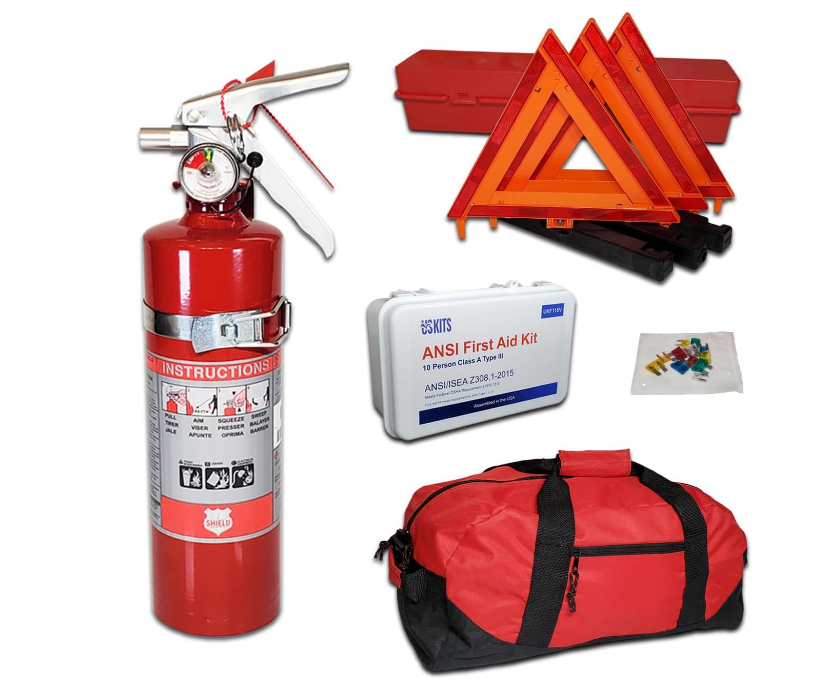
Commercial Motor Vehicle In-Cab Emergency Safety Kit
Technical Specification & Mandate
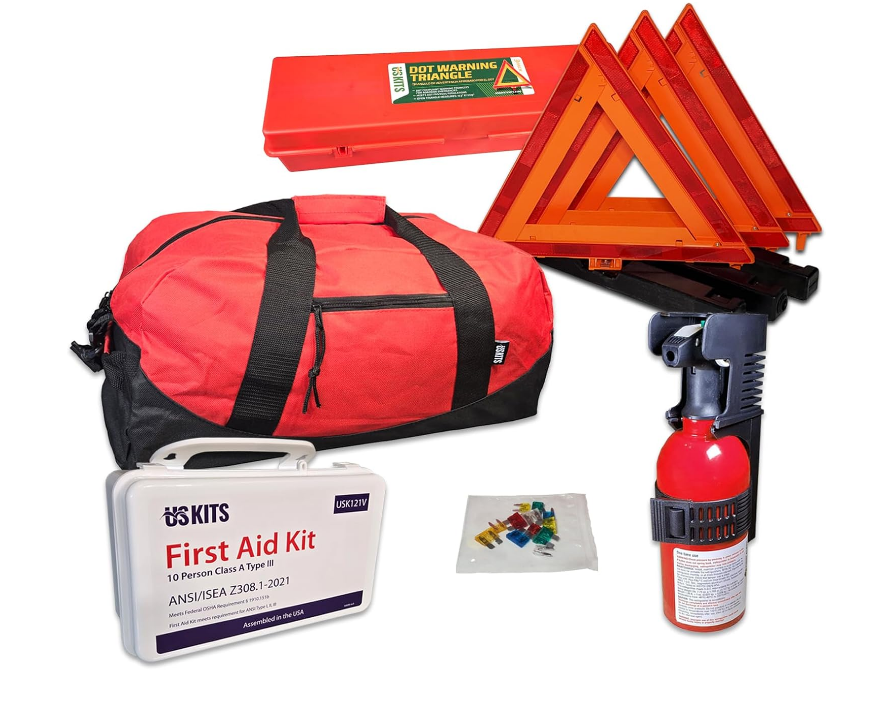
Comprehensive in-cab emergency safety package containing a UL-rated 5 B:C dry chemical fire extinguisher (or 10 B:C for hazardous materials placarded loads), three bidirectional FMVSS 125 reflective warning triangles in a high-density carrying box, an ANSI/ISEA Z308.1 Class A Type III weatherproof first aid kit, spare blade fuses, and a heavy-duty reinforced gear storage bag.
Roadside Practical Use & Deployment
Must remain permanently stowed inside the tractor cab or in an unlocked, readily accessible exterior equipment compartment. Verified during mandatory pre-trip inspections (49 CFR § 396.11) before dispatch and inspected at weigh stations and state border patrol checkpoints.
Roadside Inspection Pass/Fail Checklist
- Fire extinguisher pressure gauge needle firmly registered in the operational green zone.
- Three undamaged, clean bidirectional reflective warning triangles enclosed in their dedicated case.
- Weatherproof first aid kit stocked with sealed, non-expired trauma and burn dressings.
- Minimum of six spare electrical fuses covering all primary lighting and electronic circuit ratings.
File Your HVUT 2290 to Keep Your DOT Authority Active
A fully stocked emergency kit protects you on the highway shoulder, but an expired IRS tax watermark will sideline your truck at the weigh station. Consulics delivers your stamped Schedule 1 in minutes.
e-File HVUT 2290 Now →Commercial Vehicle Fire Extinguisher Mandates (49 CFR § 393.95(a))
Under 49 CFR § 393.95(a), every commercial power unit must be equipped with at least one dry chemical or clean agent fire extinguisher meeting strict Underwriters' Laboratories (UL) ratings. The federal standard establishes clear differentiation based on cargo classification: non-hazardous freight power units require a minimum UL rating of 5 B:C, whereas power units transporting hazardous materials requiring placarding under 49 CFR Part 172 must carry a minimum UL rating of 10 B:C.
The extinguisher chemical agent must be formulated to avoid freezing in sub-zero winter operations and must not emit toxic fumes when discharged inside an enclosed cab or sleeper berth. Carbon tetrachloride, chlorobromomethane, and toxic vaporizing liquid agents are strictly prohibited under federal law. Furthermore, the extinguisher must be securely mounted in a purpose-built bracket designed to prevent the cylinder from shifting, dislodging, or rolling during harsh deceleration or an accident.
Roadside inspectors frequently cite drivers under violation code 393.95(a) when an extinguisher is discovered rolling loose on the cab floorboard, wedged underneath a bunk mattress, or lacking an intact safety inspection tag or operational pressure charge.
| Vehicle & Cargo Classification | Mandatory UL Rating | Approved Extinguishing Agents | Mounting & Stowage Rule | CVSA Roadside Violation Code |
|---|---|---|---|---|
| General Freight / Dry Van / Reefer (>10k lbs) | 5 B:C or two 4 B:C units | Non-freezing dry chemical (monoammonium phosphate / sodium bicarbonate) | Securely mounted in rigid bracket; readily accessible | 393.95A - Fire extinguisher missing / discharged / unmounted |
| Hazardous Materials (Placarded Cargo under Part 172) | 10 B:C minimum | Non-freezing dry chemical or clean agent; zero toxic vapors | Securely mounted in cab or unlocked exterior compartment | 393.95A2 - Hazmat vehicle failing 10 B:C fire extinguisher requirement |
| Passenger Transport Commercial Vehicles | 5 B:C minimum | UL-listed non-freezing dry chemical | Mounted in driver compartment; clearly visible to operator | 393.95A - Passenger CMV fire extinguisher violation |
| Commercial Power Units Manufactured Pre-1971 | 4 B:C permitted (legacy) | Approved dry chemical agent | Secure vehicle bracket | 393.95A - Inadequate fire suppression rating |
Heavy-Duty Commercial Vehicle Dry Chemical Fire Extinguisher (UL 5 B:C / 10 B:C)
Technical Specification & Mandate
UL-listed dry chemical fire extinguisher charged with monoammonium phosphate (ABC) or sodium bicarbonate (BC) non-freezing agent. Equipped with an integrated brass pressure indicator gauge, metal pull-ring safety pin, tamper-evident security seal wire, and a heavy-gauge steel vehicle mounting bracket with quick-release retention clamp.
Roadside Practical Use & Deployment
Rapid deployment for incipient class B (flammable liquid, diesel fuel, oil, grease) and class C (energized 12V/24V electrical harness) fires. Deployed following the P.A.S.S. protocol (Pull pin, Aim at base of fire, Squeeze handle, Sweep horizontally across fire source) to extinguish brake drum heat fires, tire friction fires, or engine compartment shorts.
Roadside Inspection Pass/Fail Checklist
- Pressure indicator needle positioned solidly inside the green operating sector (not discharged or overcharged).
- Safety pull pin secured with an unbroken plastic or wire tamper seal.
- Discharge nozzle completely unobstructed by dirt, lint, or insect nesting.
- Firmly clamped inside the vehicle mounting bracket—not rolling loose on floorboards or bunk areas.
- Current inspection tag or stamped manufacturing date showing valid annual service eligibility.
Verify Form HVUT 2290 Compliance Before Roadside Safety Checks
State highway patrols and CVSA officers cross-check your active vehicle registration and IRS tax status during roadside stops. File your form HVUT 2290 online with Consulics for instant IRS verification.
Verify & File HVUT 2290 →Bidirectional Emergency Reflective Triangles (FMVSS 125 & 49 CFR § 393.95(f))
When a commercial vehicle is disabled on the shoulder or travel lane of a highway, secondary collisions represent a catastrophic hazard. Under 49 CFR § 393.95(f), power units must be equipped with at least three bidirectional emergency reflective triangles conforming to Federal Motor Vehicle Safety Standard (FMVSS) No. 125.
FMVSS 125 warning triangles are precision-engineered optical safety devices. Each triangle combines an inner triangular border of fluorescent orange plastic to catch ambient daylight with an outer perimeter of red corner-cube retroreflectors that illuminate brightly in approaching vehicle headlamps at night. To withstand the extreme aerodynamic turbulence generated by passing 80,000-lb tractor-trailers running at 70 mph, compliant triangles feature heavy ballast bases filled with silica sand or weighted steel plates capable of resisting 40 mph crosswinds without toppling.
Liquid-burning kerosene pots, red emergency flares, and open-flame devices are strictly prohibited on any power unit carrying hazardous materials, compressed flammable gases, or explosives under 49 CFR § 393.95(g). For fleet operations, reflective warning triangles are universally mandated as the standard, non-incendiary emergency signaling device across all 50 states.
| Highway Geometry & Traffic Direction | Triangle 1 (Closest to Truck) | Triangle 2 (Mid-Distance) | Triangle 3 (Long-Distance Warning) | Regulatory Placement Rule |
|---|---|---|---|---|
| Divided Highway / One-Way Multi-Lane Roadway | 10 feet (4 paces) behind truck on traffic side | 100 feet (40 paces) behind truck in center of lane/shoulder | 200 feet (80 paces) behind truck in center of lane/shoulder | All three triangles placed behind the disabled commercial motor vehicle facing oncoming traffic. |
| Two-Way Undivided Highway (Two Lanes) | 100 feet (40 paces) behind truck in center of lane/shoulder | 10 feet (4 paces) behind truck on traffic side of vehicle | 100 feet (40 paces) ahead of truck in center of lane/shoulder | Warns traffic approaching from both the front and rear directions simultaneously. |
| Vision Obscured by Curve, Hill Crest, or Obstruction | 10 feet (4 paces) behind truck on traffic side | 100 feet (40 paces) behind truck toward the crest or curve | 100 to 500 feet behind truck, placed before the visual obstruction | Extends warning perimeter up to 500 feet so approaching traffic has adequate sight stopping distance. |
| Business or Residential District (Daytime) | Hazard warning flashers activated immediately | Triangles optional unless street lighting is extinguished | Triangles mandatory at night or in dense fog/rain | Local municipal laws and state highway codes apply; hazard lights must remain active. |
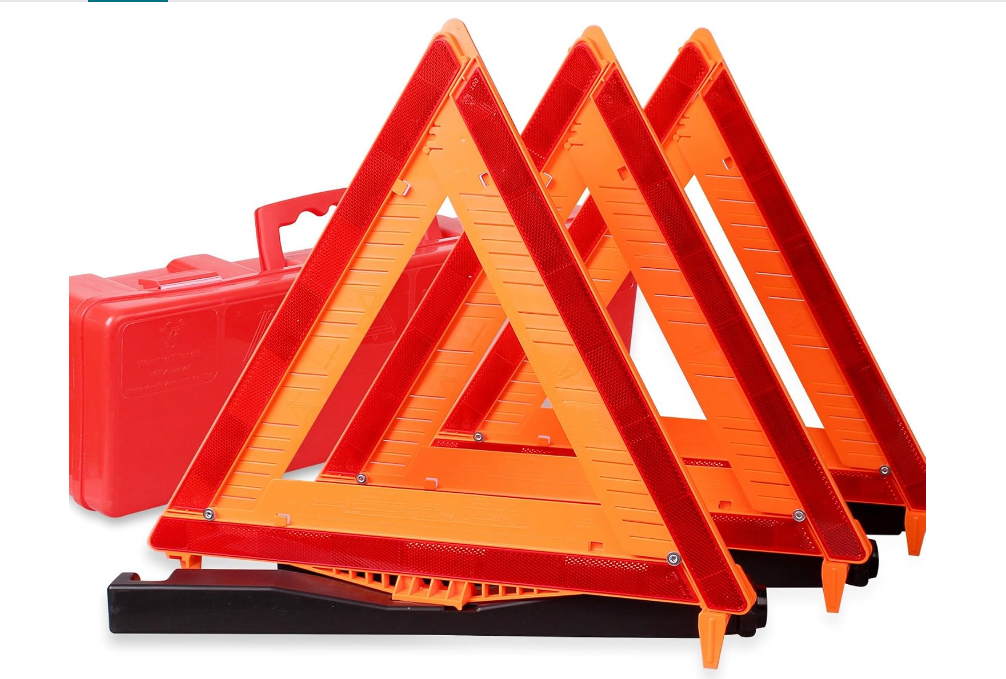
Bidirectional High-Visibility Emergency Warning Triangles (Set of 3 with Weighted Base)
Technical Specification & Mandate
Kit containing three folding triangular warning devices constructed from high-impact ABS and acrylic retroreflectors. Features fluorescent orange daylight panels and reflex-reflector night panels, non-skid rubberized ballast foot pads, interlocking hinge pins, and an impact-resistant red poly carrying case.
Roadside Practical Use & Deployment
Mandatory deployment within 10 minutes whenever a commercial vehicle stops on the traveled lane or highway shoulder for reasons other than necessary traffic stops (49 CFR § 392.22). Triangles warn approaching motorists, prevent rear-end collisions, and establish a clear safety perimeter around disabled equipment.
Roadside Inspection Pass/Fail Checklist
- Full set of exactly three (3) undamaged warning triangles present in the power unit.
- No missing, cracked, or severely scratched retroreflective prisms or fluorescent borders.
- Folding legs and central hinge locks deploy securely into an equilateral geometric triangle.
- Weighted ballast intact without leakage of internal ballast material.
- Stored inside a clean, protective red plastic casing in the cab or sleeper compartment.
The legal obligation to deploy emergency warning devices does not end with carrying the triangles in your cab. Under 49 CFR § 392.22, commercial drivers must activate the vehicle's hazard warning signal flashers immediately upon stopping, and must place the three warning triangles in exact geometric positions within 10 minutes of pulling over.
File HVUT 2290 in 5 Minutes for Instant Stamped Schedule 1
Do not let paperwork violations jeopardize your operating authority. Consulics is an IRS-authorized e-file provider that generates your official stamped Schedule 1 watermark in under 5 minutes.
File HVUT 2290 in 5 Minutes →ANSI/ISEA Z308.1-2021 & OSHA First Aid Requirements (29 CFR 1910.151(b))
Roadside emergencies frequently involve sudden physical trauma—from severe lacerations caused by snapped cargo straps and tire blowouts to thermal burns from hot coolant lines, exhaust piping, and brake drums. Under OSHA 29 CFR 1910.151(b), employers in commercial transportation must ensure ready availability of medical personnel for advice and consultation, and in the absence of an infirmary or clinic in near proximity to the workplace, a person or persons must be adequately trained to render first aid, and adequate first aid supplies must be readily accessible.
Because commercial trucks operate across isolated interstate freight corridors where emergency medical response times can exceed 30 to 45 minutes, carrying a certified first aid kit compliant with ANSI/ISEA Z308.1-2021 is industry standard for commercial fleets and responsible owner-operators.
The ANSI/ISEA standard establishes two distinct classifications for first aid kits based on workplace hazard severity: Class A kits (designed to treat the most common workplace injuries including minor cuts, abrasions, eye irritation, and first-degree burns) and Class B kits (intended for high-population industrial environments with broader ranges and quantities of trauma dressings). For commercial vehicle cabs, an ANSI Class A Type III kit is recommended: the Type III designation denotes a weather-resistant, water-resistant container with a perimeter gasket and mounting brackets, engineered to withstand the moisture, temperature extremes, and constant mechanical vibration of a heavy truck cab.
| Item Description | Minimum Required Quantity | Minimum Size / Dimension | Mandatory Clinical Purpose |
|---|---|---|---|
| Adhesive Bandages (Fabric / Plastic) | 16 units | 1" x 3" | Superficial cuts, puncture coverage, wound barrier protection |
| Adhesive Cloth First Aid Tape | 1 roll | 3/8" x 2.5 yd (minimum 5 yd total) | Securing roller gauze, splints, and bulky trauma dressings |
| Antibiotic Application Packets | 10 packets | 0.5 g each (Bacitracin / Polymyxin) | Topical infection prevention for open skin lacerations |
| Antiseptic Towelettes / Wipes | 10 packets | Pre-moistened antiseptic wipe | Wound cleaning, degreasing, and skin debridement around trauma site |
| Burn Dressing (Gel-Soaked) | 1 dressing | 4" x 4" | Cooling and sterile barrier for thermal exhaust and coolant burns |
| Burn Treatment Packets | 10 packets | 0.9 g each (water-soluble gel) | Pain relief and thermal burn heat dissipation |
| First Aid Quick Reference Guide | 1 guide | Comprehensive printed manual | Step-by-step trauma stabilization and CPR instructions |
| Medical Nitrile Exam Gloves | 2 pairs (4 gloves) | Medical grade, latex-free | Bloodborne pathogen barrier protection (OSHA 1910.1030) |
| Sterile Trauma Abdominal Pad | 2 pads | 5" x 9" | Heavy arterial or venous bleeding absorption and pressure dressing |
| Sterile Gauze Pads | 2 pads | 3" x 3" | Direct pressure and sterile packing for lacerations |
| Sterile Gauze Roller Bandage | 1 roll | 2" x 4 yd | Limb wrapping, dressing retention, and wound compression |
| Triangular Bandage | 1 bandage | 40" x 40" x 56" | Arm sling, splint stabilization, and extremity immobilization |
| Sterile Eye Wash Solution & Eye Pads | 1 oz bottle + 2 eye pads | Buffered isotonic eye wash | Flushing road grime, battery acid vapor, or diesel soot from eyes |
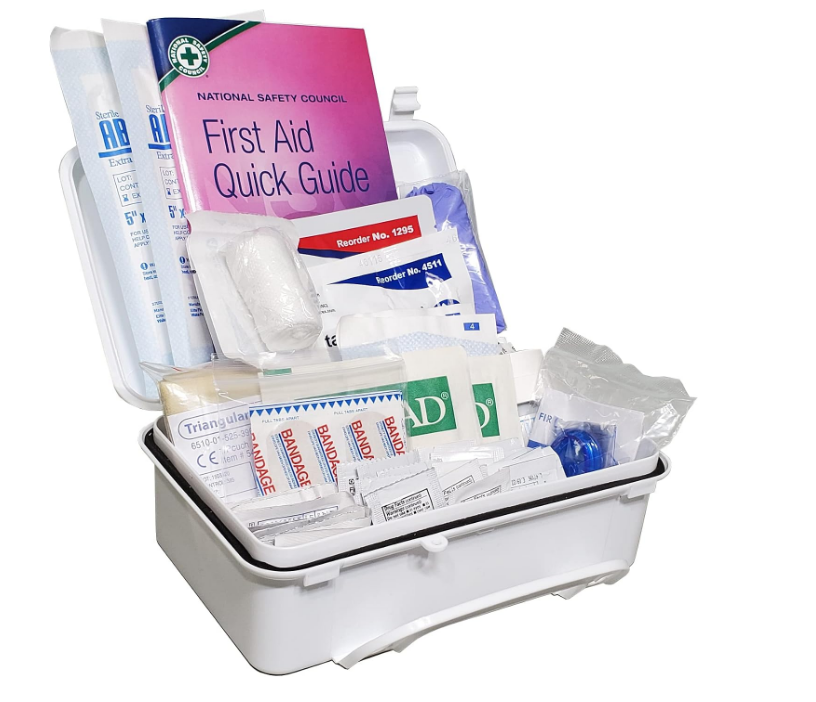
Class A Type III Weatherproof Commercial First Aid Kit
Technical Specification & Mandate
Gasket-sealed, impact-resistant industrial case equipped with ANSI-mandated life-safety items: sterile abdominal trauma pads (5"x9"), triangular bandage (40"x40"x56") for slings or tourniquet backing, sterile roller gauze, adhesive fabric bandages, antiseptic wipe packets, triple antibiotic ointment, burn dressing gel packs, sterile eye wash solution, medical nitrile exam gloves, and first aid quick guide.
Roadside Practical Use & Deployment
Immediate emergency roadside treatment for driver injuries, lacerations from sharp freight, road grime eye contamination, chemical splashes, or thermal burns during emergency mechanical adjustments. Stowed inside the cab sleeper compartment or side luggage box.
Roadside Inspection Pass/Fail Checklist
- Weatherproof rubber gasket intact and locking latches fully operational.
- Sterile trauma pads and roller bandages sealed in original moisture-barrier packaging.
- Antibiotic ointments, burn treatments, and eye wash solution within current expiration dates.
- Minimum required ANSI unit quantities verified against the printed inside-lid inventory checklist.
Choose the Best HVUT 2290 Provider for Fast IRS Watermarks
Fleet managers and independent drivers rank Consulics as the best HVUT 2290 provider for accuracy, speed, and real-time IRS error validation. Protect your commercial registration today.
Choose Best HVUT 2290 Provider →Spare Electrical Fuses Mandate (49 CFR § 393.95(e))
Electrical circuit integrity is essential for commercial motor vehicle safety. Under 49 CFR § 393.95(e), at least one spare fuse for each type and size of fuse needed to operate any required part of the commercial motor vehicle must be carried in the power unit, unless the vehicle is equipped with automatic circuit breakers.
In modern commercial tractors—including the Freightliner Cascadia, Peterbilt 579, Kenworth T680, and Volvo VNL—multiplexed electrical networks and electronic control units (ECUs) govern everything from LED lighting to air brake pressure sensors. However, standard blade fuses (ATC, ATO, Mini, and Maxi) remain the foundational safety barrier safeguarding lighting, trailer auxiliary circuits, and power distribution modules.
During a CVSA roadside inspection, an officer who observes an extinguished marker lamp or trailer clearance light will typically check whether the failure is caused by a blown fuse. If the driver cannot replace the fuse on the spot because they lack spare fuses matching the vehicle's circuit ratings, the officer will issue a violation under 393.95(e) in addition to the lighting defect violation under 393.9.
- Carry a Multi-Amp Assortment: Maintain a minimum 10-piece spare fuse assortment including 5A (tan), 10A (red), 15A (blue), 20A (yellow), 25A (clear), and 30A (green) blade fuses.
- Fuse Puller Tool Essential: Keep a dedicated plastic fuse puller clip inside the spare fuse case; pulling miniature fuses with pliers can shatter fuse casings and damage fuse block prongs.
- Know Fuse Box Locations: Commercial tractors carry multiple power distribution centers (PDCs)—typically one under the hood/firewall, one beneath the passenger-side dashboard, and one inside the sleeper bunk compartment.
- Circuit Breaker Caveat: While 49 CFR § 393.95(e) exempts vehicles with resetable automatic circuit breakers, modern trucks still utilize blade fuses for trailer auxiliary circuits and telematics.
| Electrical Circuit System | Typical Fuse Rating | Standard Fuse Form Factor | Typical Roadside Failure Symptom | CVSA Out-of-Service Risk |
|---|---|---|---|---|
| Marker / Clearance Lamps (Trailer 7-Way Pin 2) | 15 Amp or 20 Amp | ATC / Mini Blade (Blue / Yellow) | Complete trailer clearance light outage | High: Lighting failure at night triggers automatic violation |
| Stop / Turn Signals (Trailer 7-Way Pin 5 & 6) | 20 Amp or 30 Amp | ATC / Mini Blade (Yellow / Green) | No brake lights on trailer during deceleration | Immediate Out-of-Service (OOS) order under Part 393.9 |
| Tractor Headlamp High/Low Beams | 15 Amp or 25 Amp | Mini Blade / Circuit Breaker | One or both headlamps inoperative | Violation under 393.9; OOS if both low beams fail at night |
| Electronic Logging Device (ELD) & Telematics | 5 Amp or 10 Amp | ATC / Mini Blade (Tan / Red) | ELD display blacked out; power uncoupled | Immediate OOS under 395.22 for failing to record HOS data |
| Air Horn Solenoid / Cab Accessory Power | 10 Amp or 15 Amp | Mini Blade (Red / Blue) | Air horn inoperative during emergency | Inspection violation for audible warning device failure |
Get Schedule 1 Proof to Avoid DMV & DOT Safety Holds
Renewing your IRP apportioned plates or clearing a state DOT audit requires proof of tax payment. Get Schedule 1 instant PDF downloads with official IRS e-file watermarks right here.
Get Stamped Schedule 1 Now →Commercial Driver PPE: High-Visibility Safety Apparel & Heavy-Duty Work Gloves
Stepping out of a tractor-trailer cab onto an active highway shoulder or a crowded intermodal freight terminal exposes drivers to severe struck-by hazards. Under federal regulations (23 CFR Part 634 and the Manual on Uniform Traffic Control Devices (MUTCD) Section 6D.03), all commercial drivers and emergency personnel operating on federal-aid highways within the right-of-way must wear high-visibility safety apparel conforming to ANSI/ISEA 107 Class 2 or Class 3 performance standards.
An ANSI Class 2 vest incorporates fluorescent background material (high-visibility lime-yellow or fluorescent orange) combined with at least 201 square inches of retroreflective material arranged in 360-degree horizontal and vertical shoulder bands. This configuration ensures an approaching motorist traveling at 70 mph can distinguish the human silhouette from up to 1,280 feet away in low-beam headlamps, granting crucial seconds of reaction time.
In addition to high-visibility apparel, OSHA 29 CFR 1910.138 mandates that employers select and require employees to use appropriate hand protection when hands are exposed to hazards such as skin absorption of harmful substances, severe cuts or lacerations, severe abrasions, punctures, and thermal burns. Handling wire ropes, fifth-wheel release levers, rusty trailer door handles, and tire chains without heavy-duty leather-palmed work gloves leads to severe hand injuries that sideline drivers.
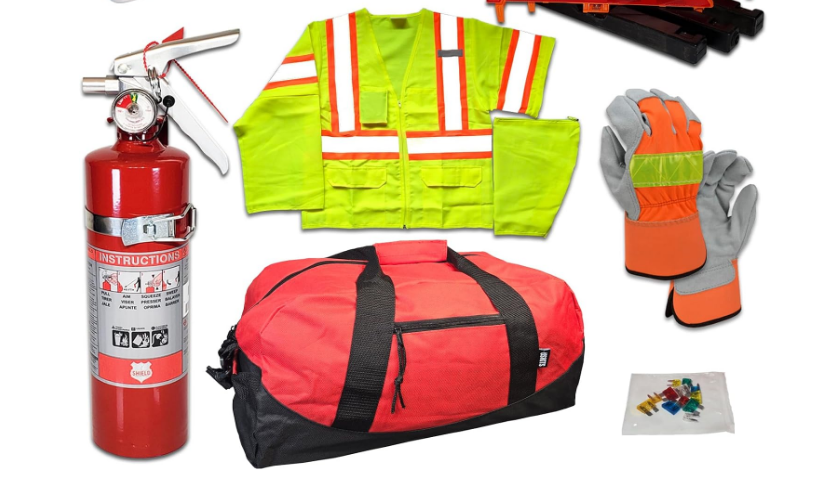
High-Visibility Reflective Safety Vest (Class 2) and Heavy-Duty Leather Work Gloves
Technical Specification & Mandate
ANSI Class 2 safety vest featuring breathable fluorescent yellow-green polyester mesh, 2-inch silver retroreflective striping with orange contrast trim, heavy-duty zipper closure, and dual chest mic tabs. Paired with heavy-duty split cowhide leather work gloves featuring reinforced leather palms, cotton safety cuffs, and retroreflective knuckle bands.
Roadside Practical Use & Deployment
Mandatory personal protective equipment (PPE) donned before stepping out of the cab for pre-trip inspections, roadside breakdown triangle placement, tire chain installation, fifth-wheel coupling checks, and warehouse loading dock maneuvering.
Roadside Inspection Pass/Fail Checklist
- Safety vest clean and free of heavy diesel fuel, grease, or road grime that obscures fluorescent fabric.
- Retroreflective tape completely intact without peeling, delamination, or severe heat cracking.
- Work gloves dry, flexible, and free from punctures or ripped palm seams.
- Stowed in driver door pocket or overhead cab console for immediate access before exiting cab.
Keep Your Fleet Road-Ready with IRS & DOT Compliance Verification
Maintain total compliance across your power units. Consulics simplifies Heavy Vehicle Use Tax e-filing for single-truck owner-operators and multi-state commercial fleets.
Maintain Fleet Compliance Now →Essential Roadside Mechanical Diagnostic Tools & Breakdown Kit
While federal statutes specifically govern fire extinguishers, warning triangles, and fuses, real-world commercial trucking survival demands a comprehensive mechanical diagnostic tool kit. According to FMCSA roadside inspection statistics, air brake violations, tire pressure defects, and lighting failures account for more than 55% of all commercial motor vehicle out-of-service orders issued in the United States.
An experienced driver equipped with basic diagnostic and mechanical equipment can resolve minor defects on the spot in under 15 minutes, preventing a 10-hour out-of-service shutdown and hundreds of dollars in expensive mobile service call-out charges. A well-prepared commercial power unit should always carry essential diagnostic tools.
| Tool / Spare Component | Recommended Technical Specification | Primary Roadside Diagnostic Function | CVSA Out-of-Service Violation Prevented |
|---|---|---|---|
| Commercial Dual-Foot Tire Pressure Gauge | Straight-on dual foot, metal barrel, calibrated 20–150 PSI | Accurately reads inner and outer dual tire inflation without valve stem bending | Tire under-inflation (<50% maximum sidewall rating triggers immediate OOS under 393.75(a)(3)) |
| Tire Tread Depth Gauge | Steel probe calibrated in 1/32" increments | Measures tread groove depth across steer, drive, and trailer tires | Steer tire tread < 4/32" or drive/trailer tread < 2/32" triggers OOS under 393.75(b)/(c) |
| Replacement Gladhand Rubber Seals (Red & Blue) | Polyurethane or nitrile rubber with integrated lip seal | Replaces split, distorted, or missing seals on tractor-to-trailer air lines | Air brake system leak exceeding FMCSA air loss rate limits (3 psi/min single, 4 psi/min combo) |
| 6V–24V Heavy-Duty Circuit Test Light | Sharp steel puncture probe with 5-foot wire and heavy alligator clamp | Isolates open circuits, blown fuses, and ground faults on tractor and trailer wiring | Extinguished trailer clearance or brake lamps during nighttime travel under 393.9 |
| High-Lumen Tactical LED Flashlight | 500+ lumens, IPX7 waterproof, magnetic tail cap | Illuminates brake pushrod stroke measurement, fifth-wheel jaw lock, and frame cracks | Detects brake adjustment defects and suspension cracks before weigh station inspection |
| Heavy-Duty Adjustable Wrench (10"–12") | Drop-forged alloy steel with precision jaw scale | Tightens loose battery terminals, mirror brackets, air line fittings, and mud flap bolts | Prevents equipment detachment and loose battery terminal electrical shorts under 393.30 |
| Electrical Wire Stripper & Splice Connectors | Multi-gauge wire crimper with heat-shrink butt connectors | Rapid roadside repair of severed trailer ABS or lighting harness wiring | Repairs damaged trailer harnesses to restore operational ABS indicator lamps under 393.55 |
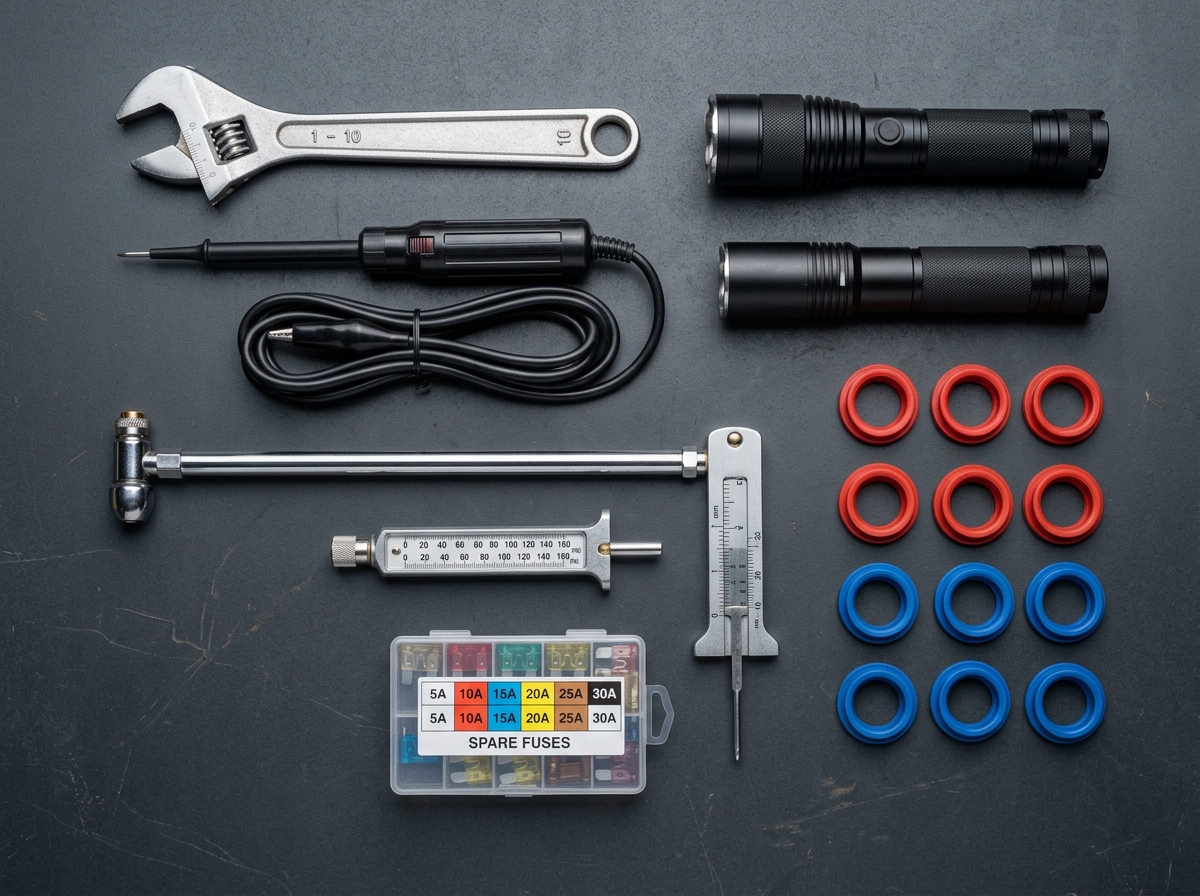
Heavy-Duty Roadside Mechanical Tool & Diagnostic Essentials Kit
Technical Specification & Mandate
Heavy-duty roadside mechanical kit featuring a commercial dual-foot straight-on tire pressure gauge (calibrated to 150 PSI for inner dual wheels), calibrated tire tread depth gauge (measured in 32nds of an inch), spare replacement red (emergency) and blue (service) rubber gladhand air seals, 6V-24V heavy-duty circuit test light with ground clamp, high-lumen waterproof LED inspection flashlight, adjustable wrench, and spare blade fuse container.
Roadside Practical Use & Deployment
Diagnostic and corrective maintenance during daily pre-trip inspections and highway disablements. Enables instant verification of tire cold inflation pressure, early detection of tire tread wear violations, immediate repair of leaking air brake gladhand couplings, and circuit tracing for trailer marker light failures.
Roadside Inspection Pass/Fail Checklist
- Dual-foot tire pressure gauge calibrated and zeroed; slide rule clean and freely moving.
- Tire tread depth gauge indicator accurate (steer tires >= 4/32", drive/trailer tires >= 2/32").
- Minimum of 4 spare gladhand rubber seals pliable without dry rot, oil saturation, or tears.
- Circuit test light bulb operational; alligator ground clip tight and uncorroded.
- High-lumen LED flashlight batteries fully charged or rechargeable battery unit topped up.
Calculate Your Annual Heavy Vehicle Tax Accurately
Avoid IRS calculation errors and costly tax penalties. Use Consulics to calculate your exact prorated or annual HVUT 2290 liability based on gross vehicle weight and first-used month.
Calculate & File HVUT 2290 →CVSA Roadside Inspection Survival Checklist: Emergency Equipment Audit
During a CVSA Level I North American Standard Inspection, the inspector follows a 37-step procedure examining both driver credentials and vehicle mechanical fitness. Emergency equipment is evaluated under Step 7 (In-Cab Inspection). Before the officer ever crawls under the chassis to measure brake pushrod travel or inspect slack adjusters, your cab safety kit is audited.
To ensure 100% compliance and zero violation points on your carrier profile, implement this rapid 3-minute morning cab equipment audit during your mandatory pre-trip inspection routine:
- Step 1: Fire Extinguisher Check (30 seconds): Verify the extinguisher is clamped firmly in its mounting bracket. Check that the pressure needle points directly in the green zone. Confirm the safety pull pin and plastic tamper seal wire are unbroken. Ensure the nozzle is clear.
- Step 2: Warning Triangles Verification (30 seconds): Open the red triangle box. Verify all three triangles are present, clean, and free of cracked reflex reflectors. Check that the weighted bases are intact and that the folding hinges lock securely.
- Step 3: Spare Fuses Confirmation (30 seconds): Open the spare fuse container. Confirm you carry at least one spare fuse for every amperage rating utilized in your cab and trailer power distribution boxes (5A, 10A, 15A, 20A, 25A, 30A) along with a fuse puller.
- Step 4: First Aid Kit Audit (30 seconds): Confirm the ANSI Class A first aid kit is stored in its designated cab location, the latch is secure, and sterile trauma dressings and eye wash bottles are within valid expiration dates.
- Step 5: High-Visibility Apparel & PPE Access (30 seconds): Ensure your ANSI Class 2 high-visibility safety vest and heavy-duty work gloves are stowed within arm's reach of the driver's seat—never buried under sleeper luggage.
By treating emergency equipment with the same operational rigor as tire inflation and air brake pressure, commercial drivers protect their safety on the road, preserve pristine SMS Vehicle Maintenance scores, and avoid costly roadside out-of-service delays.
Instant E-File Submission with Free Automatic VIN Corrections
Mistyped a VIN on your heavy vehicle tax return? Consulics provides free instant VIN corrections and immediate IRS retransmissions so your commercial trucks stay legally licensed.
Start E-Filing Form 2290 Now →Related resources
- File Form 2290 online
- How to file Form 2290, step by step
- HVUT and the stamped Schedule 1, explained
- Estimate your tax with the HVUT 2290 calculator
- Check your Form 2290 due date
- Commercial Truck Emergency Safety Kit Compliance Guide
- E-File IRS Form 2290 Online
- IRS Stamped Schedule 1 Proof of Payment
- Form 2290 Due Date & Penalty Calculator
- Commercial Truck Brands, Models & Engines Guide
- DOT New Entrant Safety Audit Preparation Guide
- FMCSA CSA Scores & SMS BASICs Optimization Guide
- Semi-Truck Preventative Maintenance (PM) Schedule
- Owner-Operator Cost-Per-Mile Budgeting Blueprint
More Form 2290 and HVUT guides
- How to Prepare for a DOT New Entrant Safety Audit: 6 Safety Factors and 16 Automatic Failure Violations
- Semi-Truck Preventative Maintenance Schedules (PM A-D) & Maintenance Cost Reduction Guide
- Commercial Truck Brands, Models & Engines Guide: Specifications, Horsepower, Torque, and Heavy Haul Ratings
- Commercial Truck Tire Safety Guide: Steer Tire Blowout Survival, Minimum Legal Tread Depths, and Maintenance Standards
- FMCSA Entry-Level Driver Training (ELDT) Guide: Theory Curriculum, BTW Testing, and TPR Compliance
- DOT Sleep Apnea Testing & CPAP Rules Guide: Screening Criteria, Compliance Hours, and Medical Card Recertification
Ready to file your Form 2290?
IRS-authorized e-filing — get your stamped Schedule 1 in minutes.
e-File Form 2290 Now →This post is general information for motor carriers, not tax or legal advice, and government rules, systems, and fees can change at any time. Confirm anything before you rely on it with the IRS, the FMCSA, or a qualified professional. Consulics does not guarantee its accuracy or currency and accepts no liability for information an agency later changes.