Commercial Tire Integrity: The Frontline of Heavy Vehicle Safety & CVSA Compliance
Tires represent the only point of physical contact between an 80,000-pound commercial motor vehicle and the asphalt roadway. Operating under severe mechanical stresses—including extreme thermal cycles, heavy gross axle weights, road debris impacts, and high cyclic rotational loads—commercial tires demand rigorous daily inspection and disciplined preventative maintenance.
Under Title 49 of the Code of Federal Regulations (49 CFR) § 393.75, the Federal Motor Carrier Safety Administration (FMCSA) establishes uncompromising statutory baselines for commercial vehicle tires. Because front steering tires govern directional stability, federal standards maintain a strict division: front steer axle tires must maintain a minimum tread depth of 4/32 inch (3.2 mm), whereas all other drive, trailer, and auxiliary axle tires must maintain at least 2/32 inch (1.6 mm).
Operating on worn, under-inflated, or mechanically damaged tires is among the most frequent violations uncovered during roadside CVSA Level I and Level II inspections. An undetected casing defect or pressure deficit not only triggers immediate Out-of-Service grounding; at highway speeds, a sudden steer tire blowout can cause catastrophic loss of vehicle control if the driver reacts with improper instincts.
- Steer Axle Minimum Tread (4/32"): Front steering tires must measure at least 4/32-inch tread groove depth everywhere, measured in two adjacent major grooves.
- Drive & Trailer Minimum Tread (2/32"): All non-steer tires must have at least 2/32-inch tread depth remaining.
- Recap / Retread Prohibition: Under 49 CFR § 393.75(d), regrooved, recapped, or retreaded tires are strictly prohibited on the front steering axle of commercial passenger buses and hazardous materials vehicles, and strongly discouraged across all Class 8 interstate operations.
- Tax & Registration Nexus: A fully compliant tire configuration ensures safe freight delivery, while keeping your Form HVUT 2290 Stamped Schedule 1 active ensures administrative compliance.
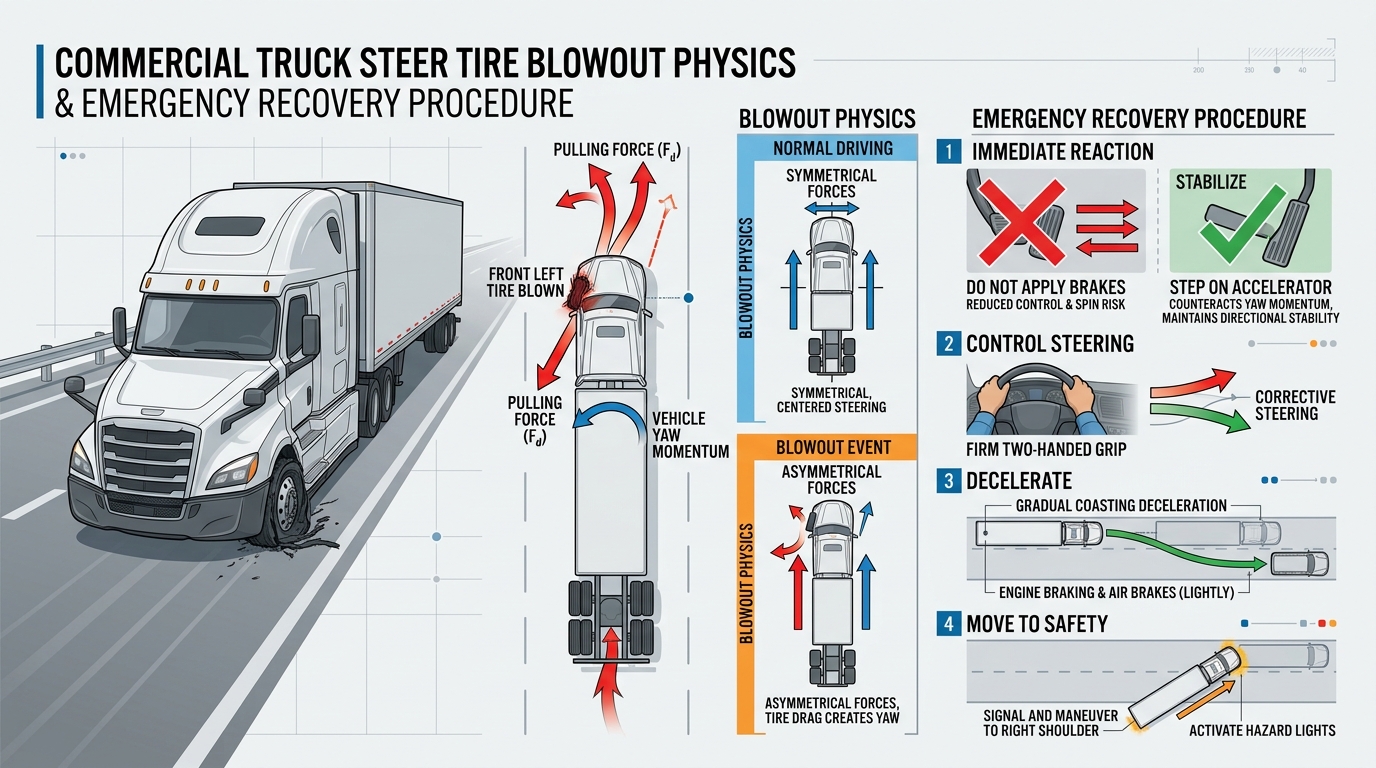
Figure 1.4: Emergency steer tire blowout survival diagram illustrating asymmetric drag yaw forces, firm two-handed steering control, the counter-intuitive accelerator application to stabilize vehicle yaw, and gradual coasting deceleration.
Maintain Your Commercial Carrier Authority with Instant Form HVUT 2290
Tire integrity keeps you safe on the highway, and an authentic IRS stamped Schedule 1 keeps your registration active. File Form HVUT 2290 with Consulics in 5 minutes.
e-File HVUT 2290 Now →The Physics of Steer Tire Blowout Survival: Why Slamming the Brakes Is Fatal
When a front steer tire detonates at 65 MPH, the natural human survival instinct is to immediately slam on the service brake pedal. In a Class 8 commercial tractor, slamming on the brakes during a steer tire blowout is the single most dangerous action a driver can take, frequently resulting in an immediate violent jackknife or rollover.
To survive a steer tire blowout, drivers must understand the underlying physics. When a steer tire loses pressure and shreds, its rolling radius drops instantly, and the shredded rubber generates enormous rolling friction on that single corner of the vehicle. This creates an intense asymmetrical yaw force ($F_d$), violently pulling the steering wheel toward the side of the blown tire.
If the driver slams on the brakes, weight instantly transfers forward onto the front axle, amplifying the downward load on the ruined rim and shredded tire while locking up the remaining good steer tire. Directional control is lost instantly. Instead, drivers must execute the counter-intuitive commercial blowout survival protocol.
- Step 1: NEVER TOUCH THE BRAKES: Resist every natural impulse to depress the brake pedal. Even applying the trailer hand trolley valve or engine retarder (Jake brake) will disrupt balance and worsen yaw instability.
- Step 2: STEP ON THE ACCELERATOR (Throttle Up): Instantly step firmly on the accelerator pedal for 2 to 4 seconds. While this feels unnatural, applying engine power pulls the tractor straight, counteracts the asymmetric drag force, and stabilizes vehicle yaw momentum.
- Step 3: GRIP THE WHEEL WITH BOTH HANDS: Anchor both hands at the 9 and 3 or 10 and 2 positions. Counter-steer firmly to hold the tractor centered in its travel lane.
- Step 4: GRADUAL COASTING & DECELERATION: Once directional control is established, slowly ease off the throttle. Allow engine compression and rolling resistance to naturally decelerate the vehicle below 35 MPH without applying service brakes.
- Step 5: GENTLE BRAKING & SHOULDER MANEUVER: Once under 30 MPH, gently feather the foot brake, signal, and guide the combination vehicle onto the right-hand emergency highway shoulder. Activate emergency four-way hazard flashers immediately.
File Form HVUT 2290 Before Your Next DMV Registration Renewal
State DMVs verify your IRS 2290 stamped Schedule 1 before issuing commercial registration tags. Consulics makes e-filing fast, secure, and IRS-authorized.
Get Stamped Schedule 1 Proof →Federal Tire Regulations Matrix: 49 CFR § 393.75 & CVSA Out-of-Service Criteria
During CVSA roadside inspections, officers inspect all 18 wheel positions on a standard combination vehicle. Below is the comprehensive regulatory matrix outlining federal FMCSA standards and exact CVSA Out-of-Service conditions.
| Wheel Position | Minimum Legal Tread Depth | Measurement Location | Critical Defect Conditions | CVSA Out-of-Service (OOS) Criteria |
|---|---|---|---|---|
| Steer Axle (Front) | 4/32 inch (3.2 mm) | Measured in two adjacent major tread grooves | Any tire with exposed cord, sidewall bulge, or ply separation | Tread depth < 2/32" in two adjacent grooves, or cord exposed, or flat tire (PSI < 50% rated). |
| Drive Axles (Tandem) | 2/32 inch (1.6 mm) | Measured in any two adjacent major tread grooves | Tread chunking > 1 inch, cuts exposing fabric, or air leaks | Both tires in dual set under 2/32", or cord exposed on both duals, or single tire flat with partner damaged. |
| Trailer Axles (Tandem) | 2/32 inch (1.6 mm) | Measured in any two adjacent major tread grooves | Dry rot cracking to ply cord, loose wheel fasteners, hub oil leaks | Tread depth < 1/32" on both duals, or severe sidewall bulge > 3/8", or tire contacting body/frame. |
| Wide-Base Singles (Super Singles) | Steer: 4/32" / Drive: 2/32" | Measured across all primary center circumferential grooves | Loss of pressure leaves zero dual redundancy | Any pressure drop below 50% of cold inflation rating, or ply cord exposed in tread/sidewall. |
Need Heavy Highway Use Tax Verification for Your Fleet?
Consulics provides enterprise fleet management tools for Form 2290 HVUT. File for dozens of trucks in one simple bulk upload.
Manage Fleet HVUT Filings →Tire Wear Diagnostics: Reading Tread Patterns to Prevent Roadside Breakdowns
Tires communicate mechanical suspension and alignment problems through distinct wear patterns long before catastrophic failure occurs. A disciplined driver can identify root chassis issues during daily pre-trip walkarounds by visually reading tire wear indicators.
| Observed Tread Wear Pattern | Visual Characteristics | Primary Root Mechanical Cause | Recommended Corrective Action |
|---|---|---|---|
| Shoulder Wear (Both Edges) | Inner and outer tread ribs worn down while center remains deep | Consistent tire under-inflation or overloading | Calibrate tire pressure with dual-foot gauge; check for slow rim valve leaks. |
| Center Tread Wear | Center circumferential ribs worn smooth while shoulders retain tread | Chronic tire over-inflation | Reduce cold tire inflation pressure to manufacturer load-chart specification. |
| One-Sided (Camber) Wear | Progressive smooth wear across one side of the tread face | Excessive wheel camber or bent steering axle | Perform total chassis 3-axle laser alignment; inspect kingpins. |
| Feathering / Diagonal Scuff | Tread blocks worn smooth on one edge and sharp on the opposite edge | Incorrect toe-in or toe-out alignment setting | Adjust steering tie rod ends to achieve factory toe specification (typically 1/16" toe-in). |
| Cupping & Scalloping | Scooped-out, wavy depressions around the tire circumference | Worn shock absorbers, loose wheel bearings, or unbalanced tire assembly | Replace worn shocks; inspect wheel bearing end-play; spin-balance tire and rim. |
Choose the Best HVUT 2290 Provider for Quick IRS Watermarks
Consulics is the #1 rated Form 2290 e-file platform for motor carriers and owner-operators nationwide. File in minutes with free VIN correction support.
e-File Form HVUT 2290 Now →Related resources
- File Form 2290 online
- How to file Form 2290, step by step
- HVUT and the stamped Schedule 1, explained
- Estimate your tax with the HVUT 2290 calculator
- Check your Form 2290 due date
- Commercial Truck Air Brake System Inspection Guide
- Commercial Truck Inspections (CVSA Levels 1–6) Guide
- Semi-Truck Preventative Maintenance (PM A-D) Schedule
- DOT & OSHA Truck Safety Kit & Tools Guide
- E-File IRS Form 2290 Online
- IRS Stamped Schedule 1 Proof of Payment
- Form 2290 Due Date & Penalty Calculator
- Commercial Truck Brands, Models & Engines Guide
More Form 2290 and HVUT guides
- Commercial Truck Winter Driving & Tire Chaining Laws Guide: State-by-State Regulations, Chain Types, and Fuel Anti-Gel
- DOT, OSHA & ANSI Truck Emergency Safety Kit & Tools Guide: FMCSA Compliance Requirements
- Commercial Truck Air Brake System Inspection & 4-Step Leakage Test Guide: FMCSA Compliance & CVSA Standards
- Carrier Lease-Purchase vs Company Driver Guide: Contract Pitfalls, Balloon Payments, and Truth in Leasing
- Semi-Truck Preventative Maintenance Schedules (PM A-D) & Maintenance Cost Reduction Guide
- How to Slide Tandems and Balance Commercial Truck Axle Weights: Federal Bridge Formula, Kingpin Rules, and CAT Scale Guide
Ready to file your Form 2290?
IRS-authorized e-filing — get your stamped Schedule 1 in minutes.
e-File Form 2290 Now →This post is general information for motor carriers, not tax or legal advice, and government rules, systems, and fees can change at any time. Confirm anything before you rely on it with the IRS, the FMCSA, or a qualified professional. Consulics does not guarantee its accuracy or currency and accepts no liability for information an agency later changes.