The High Stakes of Winter Mountain Freight: Why Tire Chain Laws Are Strictly Enforced
Navigating commercial freight through Western mountain passes during winter storm cycles presents some of the most dangerous driving environments in commercial transportation. Heavy snowpack, black ice, and freezing rain on 6% highway grades can instantaneously compromise traction for an 80,000-pound combination commercial vehicle.
To prevent stalled tractor-trailers from blocking critical interstate freight arteries, Western states—led by Colorado, California, Wyoming, Washington, and Oregon—enforce strict statutory commercial vehicle tire chain laws. Disregarding mandatory chain laws not only risks catastrophic rollover accidents; it results in immediate statutory fines exceeding $1,000, mandatory towing charges, and severe carrier SMS safety rating penalties under the FMCSA safety management system.
Commercial drivers operating across interstate corridors must know exactly when chains must be carried onboard, how many tire chains are required for their specific axle configuration, the legal acceptance of alternative traction devices (such as textile snow socks), and how to properly treat commercial diesel fuel against catastrophic fuel gelling at sub-zero temperatures.
- Carrying Mandate vs. Chaining Mandate: States like Colorado mandate that commercial trucks physically *carry* chains on designated highway corridors between September 1 and May 31, regardless of weather.
- Steep Non-Compliance Penalties: Blocking a highway lane due to lack of traction during an active chain restriction in Colorado carries a statutory $1,157 minimum fine plus towing costs.
- Approved Chain Configurations: Tandem drive tractors pulling combination trailers typically require chains on a minimum of four drive tires, with some states requiring trailer drag tire chains.
- Cross-Border Credentials: Winter freight operations require seamless compliance across state boundaries, including apportioned IRP registrations and up-to-date IRS Form 2290 Schedule 1 proof.
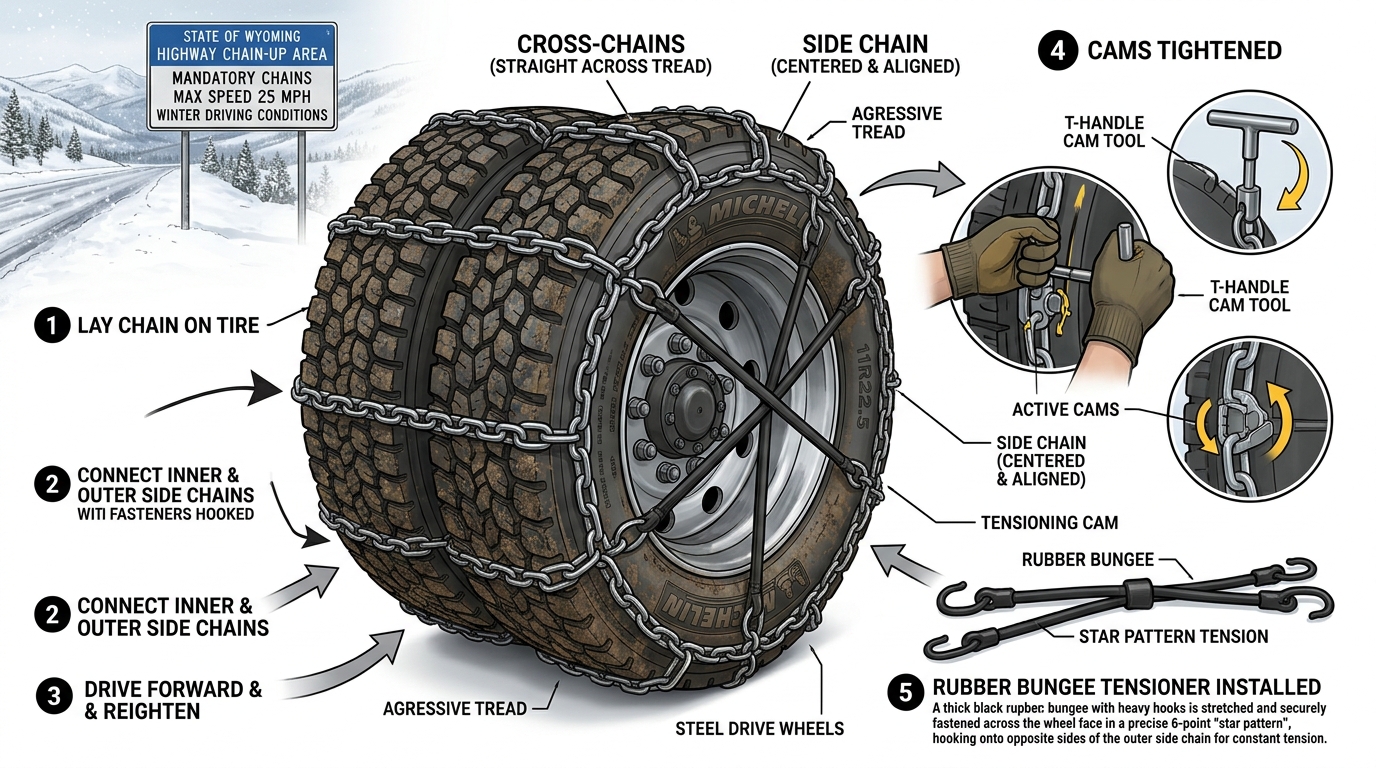
Figure 1.3: Step-by-step commercial truck tire chain installation schematic, showing cross-chain alignment, side-chain cam tightening with a T-handle tool, and heavy rubber bungee tensioner star pattern.
Keep Your Authority Active Before Hitting Winter Corridors
State troopers enforce both equipment readiness and heavy vehicle use tax compliance at mountain check stations. E-file Form HVUT 2290 with Consulics and secure your IRS Schedule 1 proof in minutes.
e-File HVUT 2290 Now →State-by-State Mandatory Commercial Tire Chain Laws Matrix
Tire chain laws vary significantly from state to state. While Midwestern and Eastern states generally permit tire chains when snow and ice are present without mandating specific seasonal onboard carriage, Western states maintain rigid statutory calendars and minimum tire chain counts.
The table below summarizes commercial vehicle chain laws across key freight transit states, detailing statutory enforcement dates, affected highway corridors, required chain configurations, and non-compliance fines.
| State | Statutory Date Range | Mandatory Corridors | Minimum Equipment Required | Alternative Traction Devices (Socks) | Statutory Fines |
|---|---|---|---|---|---|
| Colorado | Sept 1 – May 31 | I-70 (Dotsero to Morrison, MP 133–259) & all state highways | Carriage of 4 drive chains; 4 drive tires chained during Code 15; 8 chained during Code 16 | Approved for drive axles; must meet CDOT fabric standards | $500 + $79 surcharge for unchained; $1,000 + $157 surcharge if blocking lane. |
| California | Weather-dependent (active storm alerts) | I-80 (Donner Summit), US-50 (Echo Summit), I-5 (Siskiyou Summit) | R1: Chains or snow tires; R2: Chains on all CMVs (max 8 drive tires); R3: Closed to commercial traffic | Approved on trailers and secondary drives; primary drive must use conventional steel chains | Minimum $250 fine; immediate vehicle turn-around or mandatory towing. |
| Wyoming | Active variable message sign alerts | I-80, I-25, US-287, South Pass, Teton Pass | Level 1: Minimum 2 drive tires chained; Level 2: Minimum 4 drive tires chained on tandem tractor | Auto-socks permitted on secondary drive axles | $250 for non-compliance; $750 + towing if unchained truck causes highway closure. |
| Washington | Nov 1 – April 1 | I-90 (Snoqualmie Pass), US-2 (Stevens Pass), US-97 (Blewett Pass) | Carriage of chains mandatory; combo vehicles require 7 chains total (4 drive, 2 trailer, 1 spare) | Approved if certified by WSDOT as meeting RCW 46.37.530 standards | $500 for failing to carry chains; $1,000 for failing to install during active mandate. |
| Oregon | Active sign alerts (snow zone corridors) | I-5 (Siskiyou MP 1–18), I-84 (Blue Mountains MP 212–260), US-26 (Mt. Hood) | Single drive: 2 chained tires; Tandem drive: 4 chained tires + 1 trailer drag tire | Textile socks approved on single drive or secondary tandem axle | $880 statutory citation per unchained commercial power unit. |
| Utah | Oct 1 – April 30 | I-80 (Parleys Canyon), US-6 (Spanish Fork Canyon), all mountain passes | Tandem tractor: 4 drive tires chained; combo vehicle must chain 1 trailer axle for braking | Approved under UDOT Regulation R920-6 | Class B misdemeanor; fines up to $750 plus mandatory roadside delay. |
Filing HVUT 2290 for Winter Fleet Operations?
Consulics is the leading IRS-authorized Form 2290 e-file platform. Bulk upload your fleet VINs, pay through secure methods, and download your watermarked Schedule 1 proof instantly.
File Fleet Form 2290 Online →Tire Chain Types: Link Chains, Cable Chains, and Textile Snow Socks Compared
Commercial motor carriers have three primary equipment options for highway traction compliance: hardened steel link chains, cable chains, and advanced textile snow socks. Each technology presents distinct trade-offs in traction grip, weight penalty, installation speed, and road durability.
Hardened Alloy Link Chains: The traditional gold standard for heavy freight traction. Constructed from case-hardened boron steel alloy, link chains bite deeply into hard-packed ice and deep mountain snowpack. They feature cam-tighteners embedded directly in the side rails, allowing drivers to take up slack with an ergonomic T-handle tool. Their major drawback is weight: a full set of commercial tandem drive chains weighs between 80 and 120 pounds, consuming valuable payload capacity and requiring significant physical exertion to mount in sub-freezing wind chills.
Cable Chains: Constructed from high-strength galvanized steel aircraft cables wrapped in rotating alloy steel rollers. Cable chains are significantly lighter than link chains (approx. 40% lighter) and provide smoother highway ride characteristics with less vibration transferred into the tractor frame. However, on steep 6% highway grades with packed ice, cable chains provide inferior lateral bite compared to square-link steel chains and are more susceptible to snapping if spun aggressively on bare asphalt.
Textile Snow Socks (Alternative Traction Devices): Made from ultra-dense elastomeric engineered synthetic fabric with high-friction fibrous grip. Snow socks weigh less than 15 pounds per pair, take up minimal storage room in the side toolbox, and can be installed in under 5 minutes without kneeling in the snow. While legally accepted in most states as an alternative traction device, they wear rapidly if driven across exposed asphalt patches and do not offer the mechanical anchoring of steel chains on severe ice pack.
- Proper Tensioning Is Critical: 90% of broken tire chains and damaged truck fenders occur due to loose chain installation. Always install rubber bungee tensioners in a 6-point star pattern across the wheel face.
- The 50-Foot Re-Tighten Rule: After installing chains, drive the tractor forward 50 to 100 feet, dismount, and re-tighten all cams using the T-handle tool. Tire flex during initial rotation settles the side chains, revealing hidden slack.
- Speed Limit Restrictions: Never exceed 25 to 30 MPH with tire chains installed. High speeds generate immense centrifugal forces that whip loose cross-chains into aluminum fuel tanks, air brake lines, and fiberglass fenders.
E-File Form HVUT 2290 with Confidence
Consulics gives owner-operators and motor carriers the fastest route to an IRS watermarked Schedule 1. File online in minutes and keep your freight running nationwide.
Start Your Form 2290 Filing →Diesel Fuel Gelling, Anti-Gel Chemistry & Compressed Air Line Freezing
Beyond mechanical wheel traction, sub-zero winter temperatures threaten the very lifeblood of a commercial diesel engine: the fuel delivery and compressed air systems. Untreated ultra-low sulfur diesel (ULSD) naturally contains paraffin wax hydrocarbons. At warm temperatures, this wax remains dissolved in liquid solution. However, when ambient temperatures plunge, this wax precipitates out of solution in a process known as fuel gelling.
The freezing process follows two critical temperature markers: the Cloud Point (the temperature at which microscopic wax crystals first form, giving fuel a cloudy appearance, typically around 15°F to 20°F for standard #2 diesel), and the Cold Filter Plugging Point (CFPP) (the temperature at which wax crystals agglomerate and completely plug the 2-micron and 5-micron engine fuel filters, starving the high-pressure fuel pump and causing sudden engine shutdown on the highway, typically between 0°F and 10°F).
- Always Treat Fuel BEFORE Gelling: Standard anti-gel additives are preventative; they modify wax crystal growth so crystals pass through filters. They *cannot* dissolve wax once fuel has already gelled. If your engine dies from gelled fuel, you must use an emergency de-icer product containing alcohol and replace both fuel filters.
- Daily Air Tank Moisture Draining: In freezing weather, water vapor condensing in the compressed air wet tank will freeze inside brake relay valves, locking tractor-trailer brakes. Manually pull air tank drain lanyards daily until pure dry air exhausts.
- Airline Anti-Freeze (Methyl Alcohol) Precautions: While pouring certified brake line de-icer into the emergency (red) line can unfreeze stuck trailer brakes in an emergency, excessive alcohol dries out internal rubber valve diaphragms and washes away silicone grease lubricants. Use sparingly.
| Ambient Temperature Range | Fuel Blend / Additive Strategy | Wax Cloud Point | CFPP Threshold | Recommended Preventative Action |
|---|---|---|---|---|
| Above 25°F (-4°C) | Standard Summer #2 Diesel (B2–B20) | Approx. 20°F (-7°C) | Approx. 10°F (-12°C) | No chemical treatment required; drain water separator daily. |
| 25°F to 5°F (-4°C to -15°C) | Winterized #2 Diesel + Preventive Anti-Gel | Approx. 12°F (-11°C) | Approx. -5°F (-21°C) | Add 1 bottle concentrated anti-gel conditioner per 100 gallons before fueling. |
| 5°F to -15°F (-15°C to -26°C) | 70/30 Blend (#2 Diesel + #1 Kerosene) + Anti-Gel | Approx. 0°F (-18°C) | Approx. -20°F (-29°C) | Verify fuel heaters are operational; double anti-gel chemical dosage. |
| Below -15°F (-26°C) | 50/50 Blend (#2 Diesel + #1 Kerosene) + Emergency De-Icer | Approx. -10°F (-23°C) | Approx. -35°F (-37°C) | Keep engine idling at 1,000 RPM high idle; install winter radiator front cover. |
Need Form 2290 Stamped Schedule 1 for Winter DMV Registration?
Don't let tax renewal deadlines freeze your operation. Consulics delivers IRS stamped Schedule 1 verification directly to your inbox.
e-File Form HVUT 2290 Now →Related resources
- File Form 2290 online
- How to file Form 2290, step by step
- HVUT and the stamped Schedule 1, explained
- Estimate your tax with the HVUT 2290 calculator
- Check your Form 2290 due date
- DOT & OSHA Truck Safety Kit & Tools Guide
- Commercial Truck Emergency Safety Kit Requirements
- Semi-Truck Preventative Maintenance (PM A-D) Schedule
- Commercial Truck Brands, Models & Engines Guide
- E-File IRS Form 2290 Online
- IRS Stamped Schedule 1 Proof of Payment
- Form 2290 Due Date & Penalty Calculator
- Owner-Operator Cost-Per-Mile Budgeting Blueprint
More Form 2290 and HVUT guides
- Commercial Truck Tire Safety Guide: Steer Tire Blowout Survival, Minimum Legal Tread Depths, and Maintenance Standards
- DOT, OSHA & ANSI Truck Emergency Safety Kit & Tools Guide: FMCSA Compliance Requirements
- How to Slide Tandems and Balance Commercial Truck Axle Weights: Federal Bridge Formula, Kingpin Rules, and CAT Scale Guide
- Semi-Truck Parking Shortage & Reservation Guide: Jason's Law, Travel Plazas, Rest Areas, and Safe Haven Rules
- Semi-Truck Financing Guide for New Authorities: Down Payments, Credit Tiers, and Commercial Lending
- Carrier Lease-Purchase vs Company Driver Guide: Contract Pitfalls, Balloon Payments, and Truth in Leasing
Ready to file your Form 2290?
IRS-authorized e-filing — get your stamped Schedule 1 in minutes.
e-File Form 2290 Now →This post is general information for motor carriers, not tax or legal advice, and government rules, systems, and fees can change at any time. Confirm anything before you rely on it with the IRS, the FMCSA, or a qualified professional. Consulics does not guarantee its accuracy or currency and accepts no liability for information an agency later changes.