The Geometry of Commercial Axle Weight: Federal Bridge Formula & Gross Limits
In commercial freight transportation, carrying maximum revenue payload requires mastering axle weight geometry. It is entirely possible for a tractor-trailer to weigh 78,000 pounds gross—well below the statutory 80,000-pound federal gross vehicle weight limit—and yet be cited for hundreds of dollars in fines at a state DOT scale house because a single axle group is overloaded.
Under Title 23 of the Code of Federal Regulations (23 CFR) Part 658, the federal government enforces the Federal Bridge Gross Weight Formula B. Designed by civil engineers to prevent structural bridge fatigue and pavement deflection, the formula regulates the maximum weight that may be carried on any group of two or more consecutive axles based on axle spacing ($L$) and number of axles ($N$). On interstate highways, statutory limits dictate:
- Steering Axle: Maximum 12,000 lbs (or manufacturer tire load rating).
- Drive Axles (Tandem Group): Maximum 34,000 lbs.
- Trailer Axles (Tandem Group): Maximum 34,000 lbs.
- Gross Vehicle Weight Rating (GVWR): Maximum 80,000 lbs without specialized oversize/overweight permits.
- Tax Compliance Correlation: Heavy vehicles registered at 55,000 lbs and above are statutorily required to file IRS Form HVUT 2290 annually and maintain watermarked Schedule 1 proof.
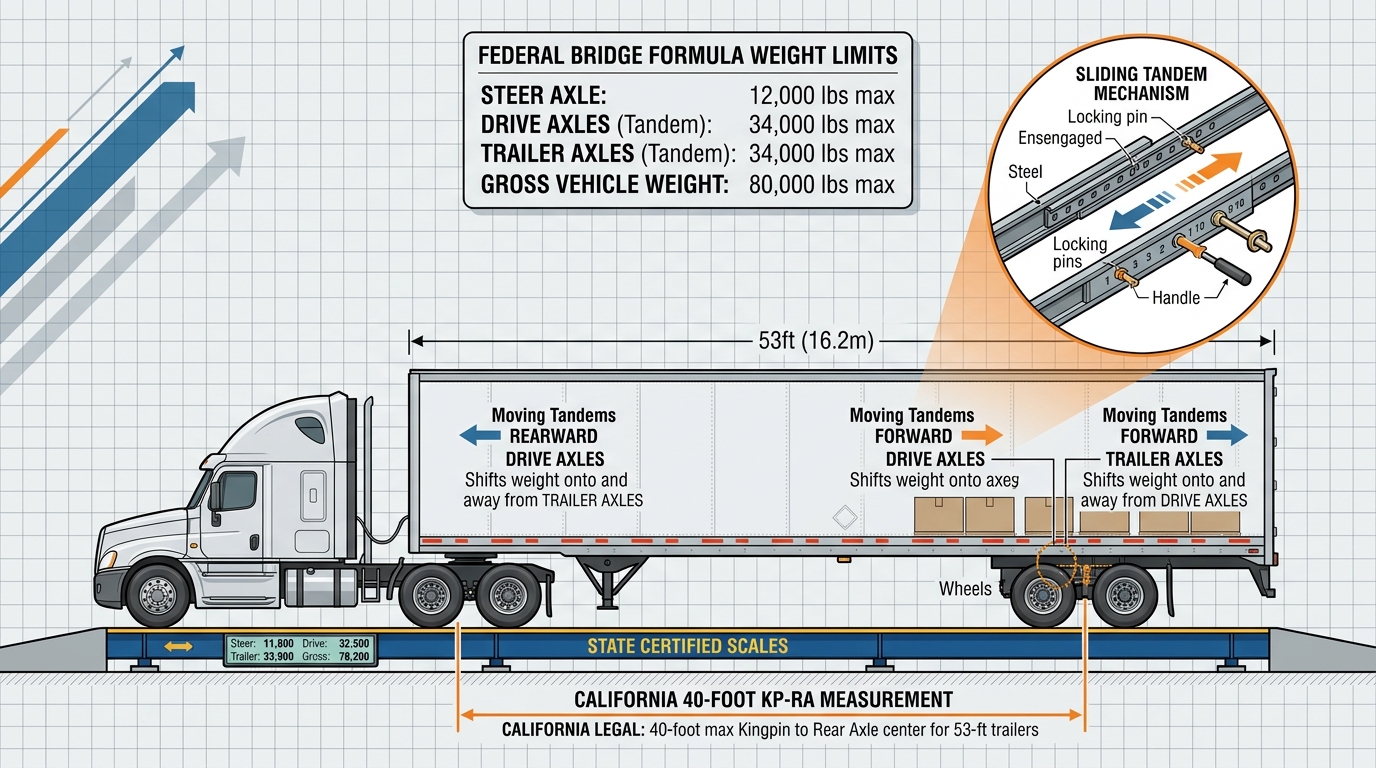
Figure 1.5: Commercial semi-truck weight distribution diagram showing 53-foot dry van on certified scales, tandem sliding rail mechanism with locking pins, directional weight shift arrows, and the California 40-foot legal kingpin-to-rear-axle measurement.
Verify Your Taxable Gross Weight Category Before Filing Form 2290
Form 2290 taxes are calculated directly from your vehicle's maximum taxable gross weight bracket. Use Consulics to calculate, verify, and e-file your HVUT return in minutes.
Calculate & File Form HVUT 2290 →The Mechanics of Sliding Tandems: The Golden Rule of Weight Transfer
To balance weight between the tractor drive tandem and the trailer tandem, 53-foot dry van and refrigerated (reefer) trailers are engineered with adjustable sliding subframes. Moving the trailer bogie wheels forward or backward shifts weight through leverage.
The fundamental rule of sliding tandems is simple: You move the tandems toward the problem.
If your trailer axles are too heavy, you slide the tandems rearward (toward the rear of the trailer). Moving the wheels backward places more of the cargo weight on the tractor drive axles, reducing trailer axle weight.
If your drive axles are too heavy, you slide the tandems forward (toward the front of the trailer). Moving the wheels forward allows the trailer overhang to lever weight onto the trailer axles, lightening the drive axles.
On standard American trailers, tandem slide rails feature pin holes spaced either 4 inches or 6 inches apart. As an operational rule of thumb:
• 4-Inch Hole Spacing: Each hole adjustment shifts approximately 250 to 300 pounds between drive and trailer tandems.
• 6-Inch Hole Spacing: Each hole adjustment shifts approximately 400 to 500 pounds between drive and trailer tandems.
| Holes Moved | Slide Direction | Estimated Weight Shift on Drives | Estimated Weight Shift on Trailer | Typical Operational Scenario |
|---|---|---|---|---|
| 1 Hole (4") | Forward | +250 to +300 lbs | -250 to -300 lbs | Fine-tuning scale reading near 34,000 lb threshold |
| 2 Holes (4") | Forward | +500 to +600 lbs | -500 to -600 lbs | Trailer at 34,400 lbs, drives at 32,800 lbs |
| 4 Holes (4") | Rearward | -1,000 to -1,200 lbs | +1,000 to +1,200 lbs | Drives overloaded at 35,100 lbs after pallet loading |
| 1 Hole (6") | Forward | +450 to +500 lbs | -450 to -500 lbs | Standard 6-inch pitch trailer fine adjustment |
| 3 Holes (6") | Rearward | -1,350 to -1,500 lbs | +1,350 to +1,500 lbs | Severe nose-heavy freight loaded at front bulkhead |
Filing Form 2290 for Heavy Highway Haulers?
Consulics provides the fastest, most reliable IRS-authorized e-filing for commercial motor carriers. Get your stamped Schedule 1 instantly.
e-File Form HVUT 2290 Online →Step-by-Step Procedure: How to Safely Slide Trailer Tandems
Sliding tandems incorrectly can shear locking pins, bend slide rails, or pull air lines. Follow this standardized commercial operational sequence every time you adjust axle positions:
- Step 1: Check Kingpin-to-Rear-Axle State Limits: Before moving pins, check whether your route traverses states with strict length caps (such as California's 40-foot rule). Never slide tandems past legal state limits.
- Step 2: Position on Flat, Level Ground: Never attempt to slide tandems on an incline or uneven surface where the trailer subframe can bind.
- Step 3: Release Tandem Locking Pins: Pull the tandem release lever on the driver-side trailer subframe. If equipped with pneumatic air-assisted release, toggle the dash or trailer switch. Ensure all four locking pins retract fully. If pins are stuck, gently rock the tractor forward and backward against the trailer brakes.
- Step 4: Set Trailer Brakes & Release Tractor Brakes: Set the red trailer parking brake valve (locking trailer wheels). Release the yellow tractor parking brake valve. The trailer wheels are now locked solid to the pavement while the tractor and trailer body can move.
- Step 5: Move Tractor in Low Gear: Put the tractor in low gear (or low reverse). Smoothly drive forward (to slide tandems rearward) or back up (to slide tandems forward) counting the pin holes as they pass.
- Step 6: Re-Engage Locking Pins: Release the locking lever or toggle the air pin switch back to the "Locked" position. Gently rock the tractor until all four locking pins audibly snap through the slide rail holes.
- Step 7: Physical Visual Inspection: Dismount from the cab and physically inspect both the driver-side and passenger-side rails. Verify all four steel locking pins protrude fully through the holes. Driving with unengaged pins will cause the trailer body to detach from the running gear during hard braking.
Stay Fully Compliant with Form HVUT 2290 E-Filing
Avoid weigh station citations and DMV registration holds. E-file Form HVUT 2290 with Consulics and secure your IRS watermarked Schedule 1 in minutes.
e-File Form HVUT 2290 Now →The California 40-Foot Kingpin-to-Rear-Axle (KP-RA) Rule & State Variations
While federal interstate bridge laws govern axle weights, individual states retain the statutory authority to regulate trailer wheelbase geometry under the Surface Transportation Assistance Act (STAA). The most famous and strictly enforced regulation in North America is California's 40-Foot Kingpin-to-Rear-Axle Rule.
Under California Vehicle Code (CVC) § 35400, on 53-foot semitrailers, the distance from the center of the kingpin to the center of the rearmost trailer axle must not exceed 40 feet 0 inches (or 38 feet 0 inches on a two-axle tandem to the midpoint between axles).
This creates a major operational dilemma for cross-country truckers: if a heavy load loaded in the Midwest requires sliding tandems all the way to the rear to keep drive axles under 34,000 lbs, that truck becomes illegal the instant it crosses into California, Florida, or Illinois, regardless of whether the gross weight is under 80,000 lbs. If your load is legal on weight only with the tandems stretched past 40 feet, the load must be physically re-worked by the shipper.
| State | Maximum Kingpin Distance | Measurement Point | Designated Highways | Roadside Enforcement Action |
|---|---|---|---|---|
| California | 40 Feet 0 Inches (12.2 m) | Kingpin to center of rear axle | All state and interstate routes | Immediate inspection citation; vehicle prohibited until tandems adjusted or escorted. |
| Florida | 41 Feet 0 Inches | Kingpin to center of rear axle / midpoint | All non-special permit highways | Civil citation fine; required to slide tandems if weight allows. |
| Illinois | 42 Feet 6 Inches (Class I/II highways) | Kingpin to center of rear tandem axle | State routes & secondary roads | Tandem adjustment citation; weight re-verification. |
| Michigan | 40 Feet 6 Inches | Kingpin to center of tandem assembly | Designated state highway network | Misdemeanor traffic infraction; scale delay. |
| Tennessee | 41 Feet 0 Inches | Kingpin to center of rear axle group | Non-interstate state highway system | Inspection citation during commercial enforcement details. |
Fast, Accurate E-Filing for Commercial Motor Carriers
Consulics is built for the realities of modern commercial trucking. File Form HVUT 2290 online, get instant IRS watermarks, and maintain complete compliance across all 50 states.
File Your Form HVUT 2290 Today →How to Weigh on Certified Commercial Scales and Use Connected Mobile Platforms
The only definitive way to confirm that your axle weights are legal before entering a state DOT weigh station is to weigh your tractor-trailer on a certified commercial automated truck scale.
Modern commercial scales feature three or four isolated weighing platforms positioned sequentially. When driving onto the scale platform:
• Platform 1: Front steer axle.
• Platform 2: Tractor drive axle tandem group.
• Platform 3: Trailer axle tandem group.
Using the mobile driver weigh application, drivers no longer need to park and walk inside the truck stop fuel desk. The mobile platform detects scale location via GPS, processes payment automatically, and displays certified steer, drive, trailer, and gross weights on screen within seconds.
If the certified scale ticket reveals that drives are at 34,800 lbs and trailer axles are at 32,400 lbs, the driver can immediately slide tandems 2 to 3 holes forward, re-weigh for an inexpensive re-weigh fee (typically under $3.00), and verify 100% legal weight distribution before rolling past the next state inspection station.
- Ensure All Axles Rest on Correct Platforms: Verify that your steer axle rests fully on platform 1, drives on platform 2, and trailer on platform 3. Crossing a platform seam produces an erroneous scale reading.
- Check Fuel Weight Capacity: Remember that diesel fuel weighs approximately 7.1 pounds per gallon. If you weigh with empty fuel tanks and subsequently fill 200 gallons of fuel, you will add approximately 1,420 pounds, split between your steer and drive axles.
- Certified Weight Guarantee: Certified commercial scales guarantee their weight tickets; if a carrier is cited for an overweight axle while possessing a scale ticket showing legal weights taken on the same trip, the scale company defends the citation or reimburses the fine.
File Form HVUT 2290 with Consulics Today
Keep your heavy highway fleet running legally with fast, dependable Form 2290 e-filing. Get your stamped Schedule 1 in minutes.
e-File Form HVUT 2290 Now →Related resources
- File Form 2290 online
- How to file Form 2290, step by step
- HVUT and the stamped Schedule 1, explained
- Estimate your tax with the HVUT 2290 calculator
- Check your Form 2290 due date
- Commercial Truck Brands, Models & Engines Guide
- Owner-Operator Cost-Per-Mile Budgeting Blueprint
- Semi-Truck Preventative Maintenance (PM A-D) Schedule
- Commercial Truck Inspections (CVSA Levels 1–6) Guide
- E-File IRS Form 2290 Online
- IRS Stamped Schedule 1 Proof of Payment
- Form 2290 Due Date & Penalty Calculator
- DOT & OSHA Truck Safety Kit & Tools Guide
More Form 2290 and HVUT guides
- Privately Purchased Commercial Trucks: Form 2290 Rules, State DMV 60-Day Limits, and Title Transfers
- Commercial Truck Winter Driving & Tire Chaining Laws Guide: State-by-State Regulations, Chain Types, and Fuel Anti-Gel
- Commercial Truck Air Brake System Inspection & 4-Step Leakage Test Guide: FMCSA Compliance & CVSA Standards
- DOT Sleep Apnea Testing & CPAP Rules Guide: Screening Criteria, Compliance Hours, and Medical Card Recertification
- DOT Physical Blood Pressure Limits Guide: Stages 1-3, Certification Durations, and Passing Protocols
- Semi-Truck Parking Shortage & Reservation Guide: Jason's Law, Travel Plazas, Rest Areas, and Safe Haven Rules
Ready to file your Form 2290?
IRS-authorized e-filing — get your stamped Schedule 1 in minutes.
e-File Form 2290 Now →This post is general information for motor carriers, not tax or legal advice, and government rules, systems, and fees can change at any time. Confirm anything before you rely on it with the IRS, the FMCSA, or a qualified professional. Consulics does not guarantee its accuracy or currency and accepts no liability for information an agency later changes.