Commercial Air Brake Foundations: Why Brake Violations Dominate Roadside Out-of-Service Citations
According to annual Commercial Vehicle Safety Alliance (CVSA) International Roadcheck data, brake system defects account for nearly 40% of all commercial vehicle Out-of-Service (OOS) violations issued across North American highways. An 80,000-pound combination tractor-trailer traveling at 65 MPH carries massive kinetic energy, relying entirely on compressed air pneumatic systems to actuate foundation S-cam drum or disc brakes.
Unlike hydraulic passenger vehicles where fluid leaks cause soft pedals, commercial air brake systems use compressed air generated by an engine-driven compressor, stored in supply (wet), primary (rear axle), and secondary (front/steer axle) pneumatic reservoirs. When the driver depresses the foot treadle valve, air rushes into brake chambers, forcing a flexible rubber diaphragm against a pushrod. The pushrod rotates a slack adjuster, which turns an S-cam shaft, forcing brake shoes outward against the rotating steel brake drum.
Because safety is paramount, commercial vehicles incorporate fail-safe spring emergency brakes. Heavy internal coil springs (often referred to as the "parking brake" or "emergency brake") are held compressed by continuous air pressure during transit. If system air pressure bleeds away or lines rupture, the air holding the spring back exhausts, allowing the mechanical coil spring to forcefully expand and clamp the brakes. Conducting the statutory 4-step in-cab air brake test is not merely a CDL licensing requirement; it is a vital daily mechanical procedure mandated under 49 CFR § 396.13.
- Pneumatic Operating Pressure: Systems maintain optimal working air pressure between 100 and 130 PSI across primary and secondary storage tanks.
- Spring Emergency Fail-Safe: Heavy mechanical coil springs inside Type 30/30 brake chambers actuate automatic emergency stopping if air pressure plummets below 45 PSI.
- Automatic Slack Adjusters (ASAs): Mandated since 1994 to maintain pushrod stroke tolerances automatically; manual adjustment of an ASA is prohibited under CVSA inspection guidelines without inspecting internal clutch mechanisms.
- Regulatory Integration: A clean air brake pre-trip inspection protects life and cargo, just as maintaining current IRS Form 2290 HVUT compliance protects operating credentials from state suspension.
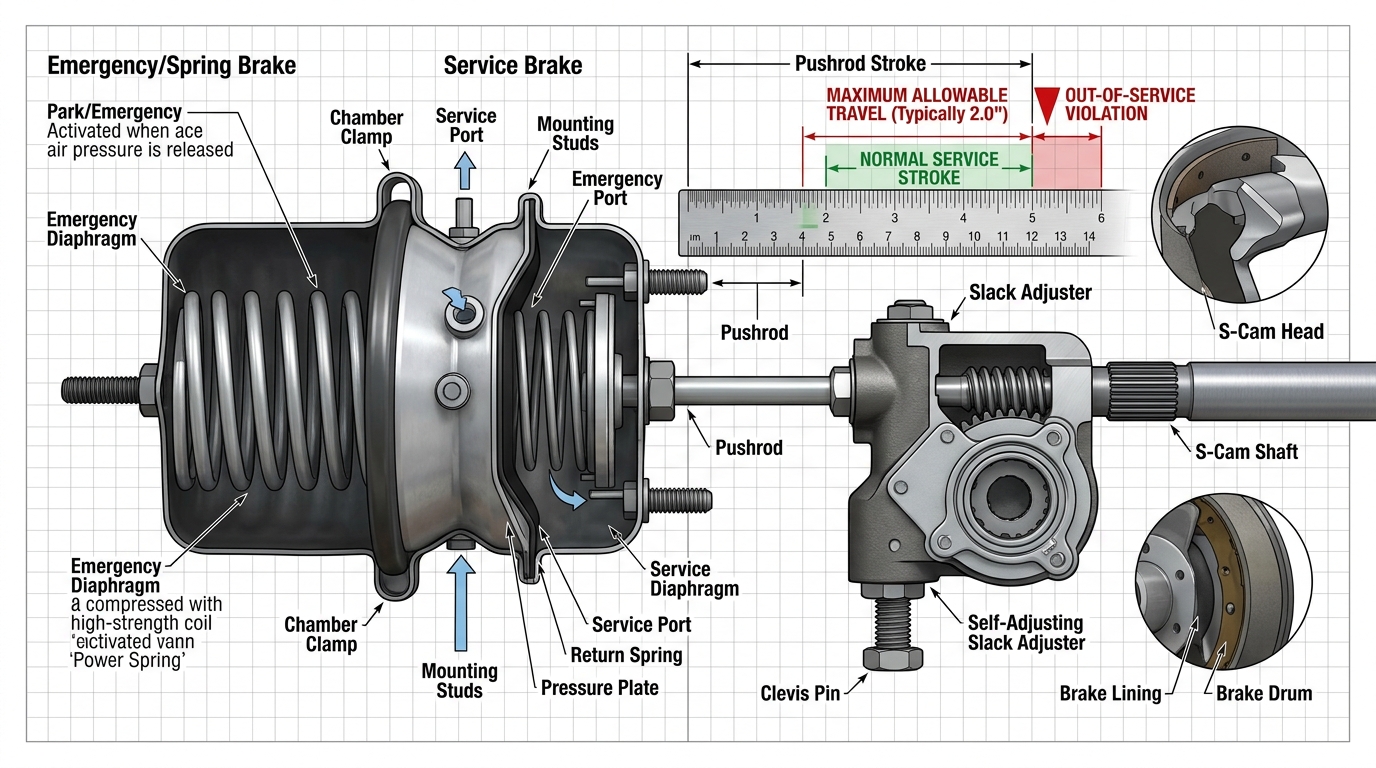
Figure 1.2: Cross-sectional engineering diagram of a commercial truck Type 30/30 dual air brake chamber, demonstrating emergency spring, service diaphragm, pushrod stroke, and slack adjuster assembly with CVSA out-of-service measurement ruler.
Ensure Total Roadside Readiness with Form HVUT 2290 E-Filing
CVSA officers inspect mechanical brake systems alongside operating credentials and tax records. File Form HVUT 2290 with Consulics to secure IRS Schedule 1 verification in minutes.
e-File Form HVUT 2290 Now →The Mandatory 4-Step In-Cab Air Brake Leakage Test: Sequence & Pass/Fail Criteria
Every commercial driver operating a Class A combination vehicle or Class B straight truck must execute the complete in-cab air brake inspection before departure. Federal inspectors during a CVSA Level I inspection will frequently request the driver demonstrate this exact sequence from the cab. Failing any single step results in an immediate failure and potential out-of-service grounding.
The test must be performed in a precise, logical order to systematically verify static seal integrity, applied pedal seal integrity, low air audible/visual warning devices, and tractor protection spring brake pop-out thresholds. Chock the wheels on level ground before starting.
- Step 1: Applied Leakage Test (The 1-Minute Pressure Drop Check): Build air pressure to governor cut-out (approx. 125 PSI). Turn the engine off, then turn the ignition key back to the "ON/RUN" position without restarting the engine. Push in both the yellow parking brake and red trailer air supply valves to release all brakes. Allow air gauges to stabilize. Firmly press and hold the service brake pedal down. Once stabilized, time for one full minute (60 seconds). The maximum allowable air loss is no more than 3 PSI in one minute for a straight truck, and no more than 4 PSI in one minute for a tractor-trailer combination.
- Step 2: Low Air Warning Device Activation Test: With the ignition key in the "ON" position and the engine off, repeatedly pump (fan) the service brake foot treadle valve to bleed air pressure down from the tanks. Observe the primary and secondary air pressure gauges. The low-air warning buzzer and dash warning light must illuminate and sound at or before tank pressure drops to 60 PSI (statutory range: 55 to 75 PSI). If the buzzer fails to sound or the light fails to illuminate, the vehicle is illegal to dispatch.
- Step 3: Tractor Protection Valve & Parking Brake Pop-Out Test: Continue pumping the service brake pedal down to further deplete air pressure. Watch the dash-mounted red octagonal trailer air supply valve and yellow diamond parking brake knob. Between 20 and 45 PSI, both knobs must automatically "pop out" with an audible exhaust blast, engaging the emergency spring brakes on both tractor and trailer. If either knob fails to pop out automatically, the tractor protection system is defective.
- Step 4: Air Compressor Build-Rate & Governor Cut-In / Cut-Out Test: Start the engine and fast-idle at 1,000–1,200 RPM. Measure the air pressure build rate: tank pressure must climb from 85 PSI to 100 PSI within 45 seconds in dual air systems. Observe governor cut-out: between 120 and 140 PSI, the air dryer will emit a loud, distinct "air purge" blast, signaling the compressor has unloaded. Finally, gently pump the brakes until pressure drops 20–25 PSI; verify the governor cuts back in to resume pumping air before pressure drops below 100 PSI.
| Inspection Stage | Operational Step | Acceptable Regulatory Range | Strict Failure Threshold | CVSA Enforcement Action |
|---|---|---|---|---|
| Static Air Loss | Engine Off, Brakes Released, 1 Min | Max 2 PSI (Straight) / 3 PSI (Combo) | > 3 PSI drop in 60 seconds | Safety violation citation; inspect air fittings. |
| Applied Leakage | Engine Off, Full Brake Pedal, 1 Min | Max 3 PSI (Straight) / 4 PSI (Combo) | > 4 PSI drop in 60 seconds (Combo) | Immediate Out-of-Service if audible leak detected. |
| Low Air Warning | Fan Brakes with Ignition On | Buzzer/Light activates at 55–75 PSI | Fails to activate above 55 PSI | Out-of-Service under 49 CFR § 393.51. |
| Emergency Pop-Out | Continue Fanning Brakes | Knobs pop out between 20–45 PSI | Knobs stay in below 20 PSI | Out-of-Service; failed tractor protection system. |
| Compressor Build | Engine at Fast Idle (1,200 RPM) | 85 to 100 PSI in under 45 seconds | Takes > 60 seconds to build 15 PSI | Out-of-Service; weak air compressor or severe leak. |
| Governor Cut-Out | Air Tanks at Full Capacity | Purge valve fires at 120–140 PSI | Pressure climbs past 145 PSI without purge | Out-of-Service; safety relief valve danger. |
Stay Compliant on Brakes and IRS Highway Taxes
Don't let a paperwork violation compound a mechanical inspection. Keep your carrier credentials immaculate with Consulics instant IRS Form 2290 e-filing.
e-File Form HVUT 2290 Online →Slack Adjuster Pushrod Stroke Limits: The 20% Brake Out-of-Service Rule
During a CVSA Level I roadside inspection, certified enforcement officers crawl underneath the tractor-trailer with a creeper, a ruler, and a chalk marker to physically measure brake chamber pushrod stroke. This measurement represents the mechanical travel distance the pushrod moves when 90 to 100 PSI of air is applied to the chamber.
If the brake drum has worn, the brake shoes are thinned, or the automatic slack adjuster internal pawl is slipping, the pushrod travels too far. Under the North American Standard Out-of-Service Criteria, if 20% or more of the serviceable brakes on a commercial vehicle combination are out of adjustment, the entire vehicle is placed immediately Out of Service (OOS). On a standard 5-axle 18-wheel tractor-trailer (which has 10 total brake chambers), having just two brakes out of adjustment results in an immediate red OOS sticker, prohibiting the truck from moving until a mobile mechanic completes certified repairs.
It is critical to note that brake chambers come in two major body configurations: standard clamp-type chambers and long-stroke clamp-type chambers (distinguished by square air ports or trapezoidal embossed ID tags). The maximum allowable pushrod travel differs substantially between them.
- Never Manually Adjust an ASA as Routine Maintenance: Automatic slack adjusters are designed to self-adjust during normal brake applications. If an ASA exceeds stroke limits, manually adjusting it only masks underlying mechanical wear (worn cam bushings, bent clevis pins, or seized internal clutch). It must be mechanically inspected and replaced.
- Identify Long-Stroke Chambers: Long-stroke chambers feature square-shaped air intake ports or embossed identification tags. Mistaking a standard chamber for a long-stroke chamber leads to improper adjustment and immediate roadside citation.
- Brake Shoe Friction Lining Minimums: Under 49 CFR § 393.47, drum brake friction lining thickness must never be less than 1/4 inch (6.4 mm) at the center of the shoe, and air disc brake pads must not be worn below 1/8 inch (3.2 mm).
| Chamber Type | Chamber Outside Diameter | Chamber Configuration | Max Allowable Stroke (Standard) | Max Allowable Stroke (Long-Stroke) | OOS Threshold Exceeded |
|---|---|---|---|---|---|
| Type 16 | 6-3/8 inches | Clamp Type | 1-3/4 inches (44 mm) | 2.0 inches (51 mm) | Travel exceeds rated stroke by 1/8" |
| Type 20 | 6-25/32 inches | Clamp Type | 1-3/4 inches (44 mm) | 2.0 inches (51 mm) | Travel exceeds rated stroke by 1/8" |
| Type 24 | 7-7/32 inches | Clamp Type | 1-3/4 inches (44 mm) | 2.0 inches (51 mm) | Travel exceeds rated stroke by 1/8" |
| Type 30 | 8-3/32 inches | Standard Clamp Type | 2.0 inches (51 mm) | N/A | Pushrod travel measured at 2-1/8" or greater |
| Type 30 (LS) | 8-3/32 inches | Long-Stroke Clamp Type | N/A | 2-1/2 inches (64 mm) | Pushrod travel measured at 2-5/8" or greater |
| Type 36 | 9 inches | Heavy Heavy-Haul Clamp Type | 2-1/4 inches (57 mm) | N/A | Pushrod travel measured at 2-3/8" or greater |
Filing HVUT 2290 Before Your Next CVSA Inspection?
Consulics provides 24/7 cloud e-filing for IRS Form 2290. Generate your stamped Schedule 1 to present to state authorities and avoid administrative downtime.
Start Your Form 2290 Filing →Related resources
- File Form 2290 online
- How to file Form 2290, step by step
- HVUT and the stamped Schedule 1, explained
- Estimate your tax with the HVUT 2290 calculator
- Check your Form 2290 due date
- Commercial Truck Inspections (CVSA Levels 1–6) Guide
- DOT & OSHA Truck Safety Kit & Tools Guide
- Commercial Truck Emergency Safety Kit Requirements
- Semi-Truck Preventative Maintenance Schedules
- E-File IRS Form 2290 Online
- IRS Stamped Schedule 1 Proof of Payment
- Form 2290 Due Date & Penalty Calculator
- FMCSA CSA Scores & SMS BASICs Optimization Guide
More Form 2290 and HVUT guides
- Class A CDL Pre-Trip Inspection Checklist & Memory Script: 7-Step Walkaround & In-Cab Testing Guide
- DOT Sleep Apnea Testing & CPAP Rules Guide: Screening Criteria, Compliance Hours, and Medical Card Recertification
- Weigh Station Bypass Guide: Transponders vs Mobile Systems, ISS Scores, and CVSA Bypass Rates
- Commercial Truck Tire Safety Guide: Steer Tire Blowout Survival, Minimum Legal Tread Depths, and Maintenance Standards
- FMCSA Entry-Level Driver Training (ELDT) Guide: Theory Curriculum, BTW Testing, and TPR Compliance
- DOT Physical Blood Pressure Limits Guide: Stages 1-3, Certification Durations, and Passing Protocols
Ready to file your Form 2290?
IRS-authorized e-filing — get your stamped Schedule 1 in minutes.
e-File Form 2290 Now →This post is general information for motor carriers, not tax or legal advice, and government rules, systems, and fees can change at any time. Confirm anything before you rely on it with the IRS, the FMCSA, or a qualified professional. Consulics does not guarantee its accuracy or currency and accepts no liability for information an agency later changes.