FMCSA Passenger Carrier Classification: When Does a Limo, Van, or Bus Become a Commercial Motor Vehicle?
In commercial transportation, few sectors encounter more regulatory confusion than for-hire passenger transportation. Operators of luxury limousines, party buses, executive Mercedes-Benz Sprinter vans, and full-size motorcoaches frequently assume that passenger comfort vehicles are exempt from the stringent commercial safety regulations that govern 80,000-pound freight tractor-trailers. Under federal law, this assumption is completely incorrect.
Under Title 49 of the Code of Federal Regulations (49 CFR) § 390.5, the Federal Motor Carrier Safety Administration (FMCSA) defines a Commercial Motor Vehicle (CMV) based on two distinct passenger capacity thresholds:
- The 9 to 15 Passenger Rule (For-Hire): Any vehicle designed or used to transport 9 to 15 passengers (including the driver) for direct or indirect compensation operating in interstate commerce is classified as a commercial motor vehicle. Operators must register for a USDOT number, maintain Driver Qualification Files (DQFs), follow Hours of Service (HOS) rules, and carry at least $1,500,000 in public liability insurance.
- The 16+ Passenger Rule (For-Hire or Private): Any vehicle designed or used to transport 16 or more passengers (including the driver)—regardless of whether compensation is charged—is a statutory CMV. This classification mandates a Commercial Driver's License (CDL) with Passenger endorsement, federal drug testing consortium enrollment, and $5,000,000 in public liability insurance.
- Limousines and Stretched Sedans: Traditional stretched limousines designed for 8 or fewer passengers are generally exempt from federal FMCSRs unless crossing state lines with a gross combination weight rating exceeding 10,000 lbs. However, SUV stretch limousines, Hummer limos, and executive shuttle vans configured for 9 or more passengers fall directly under federal oversight.
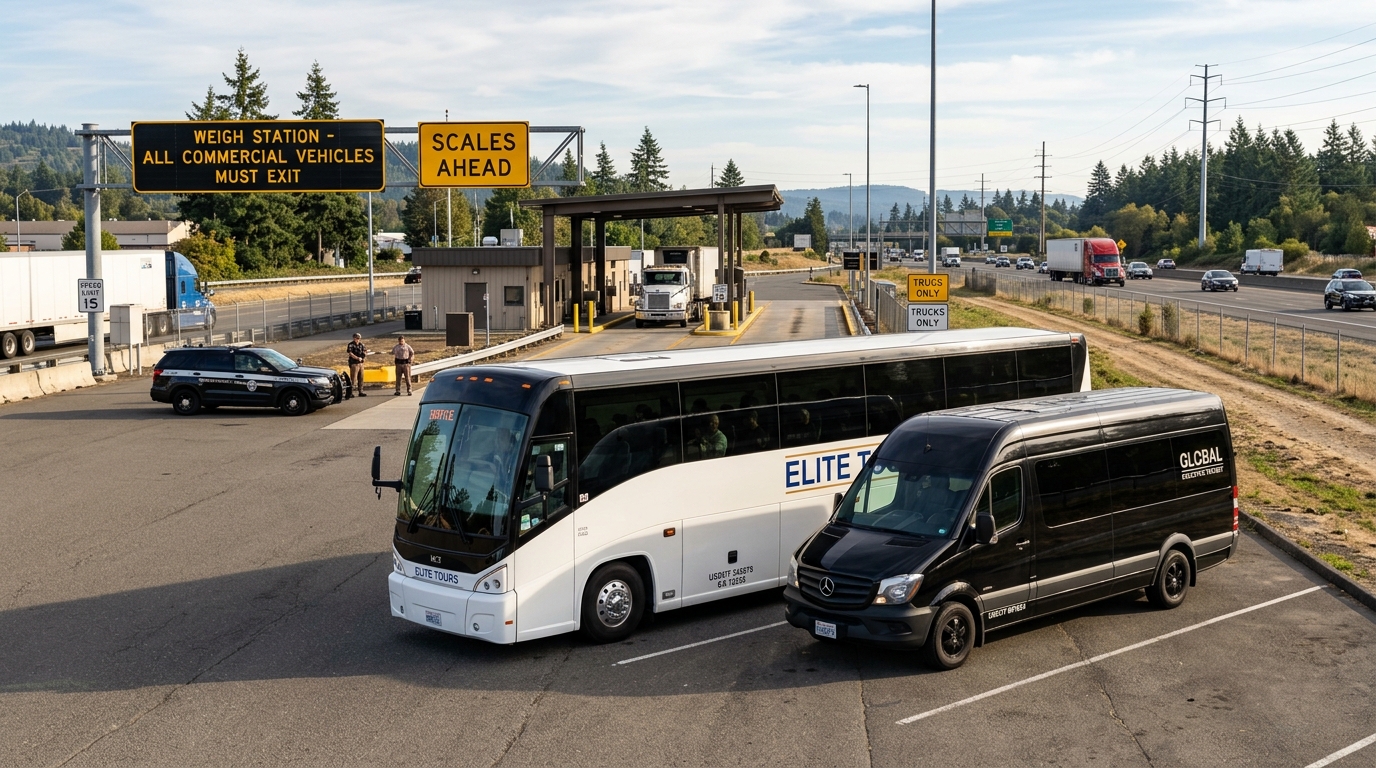
Figure 6.4: Commercial motorcoaches and passenger transport vans are subject to strict FMCSA passenger carrier regulations, state weigh station mandates, and federal excise tax filings.
Operating Heavy Commercial Passenger Motorcoaches?
Motorcoaches with a gross weight of 55,000 lbs or more require annual IRS Form 2290 filing before state DMVs will issue passenger plates. E-file with Consulics and get your stamped Schedule 1 in minutes.
e-File Form HVUT 2290 Now →Weigh Station Regulations for Passenger Carriers: Do Buses, Party Buses, Vans & Limos Have to Stop?
One of the most intensely searched questions among professional chauffeurs and bus operators is whether passenger transport vehicles are legally required to pull into highway weigh stations and commercial vehicle inspection stations.
Unlike federal safety rules, weigh station pull-in mandates are governed entirely by individual state statutes. Most states base weigh station entry on either Gross Vehicle Weight Rating (GVWR) (typically vehicles over 10,000, 16,000, or 26,000 lbs) or on commercial vehicle classification. Because passenger vehicles carry human lives rather than inanimate cargo, state policies vary substantially across jurisdictions.
- Full-Size Motorcoaches (Charter, Tour & Intercity Buses): In most states (including California, Pennsylvania, Florida, and Virginia), motorcoaches over 26,000 lbs must pull into open weigh stations unless the vehicle is enrolled in an automated electronic bypass program (such as PrePass or Drivewyze) and receives a green bypass signal.
- Party Buses and Converted Shuttles: Converted school buses, party buses, and freightliner shuttle buses registered over the state weight threshold (typically 10,000 or 16,000 lbs) are strictly required to stop. Roadside enforcement officers heavily scrutinize party buses for emergency exit window compliance, fire extinguishers, passenger capacity overloads, and driver CDL endorsements.
- Sprinter Vans & Small Passenger Vans (9–15 Passengers): In states like California (where all commercial vehicles over 10,000 lbs must stop) and Georgia, commercial passenger vans must pull into open scales. In states that define weigh station entry solely by freight hauling (e.g. Texas, which focuses on property carriers), passenger vans are frequently permitted to bypass, provided commercial signage does not explicitly command "All Passenger Buses Must Enter."
- Stretch Limousines: Standard livery sedans and 6-to-8 passenger limousines are exempt from weigh stations in nearly every state. However, super-stretch SUV limousines with a GVWR exceeding 10,000 or 26,000 lbs must follow highway roadside signage indicating weight thresholds.
| State Jurisdiction | Weight Threshold / Rule | Passenger Buses & Motorcoaches | Party Buses & Converted Shuttles | Limousines (Under 10k lbs) |
|---|---|---|---|---|
| California (Caltrans / CHP) | 10,001+ lbs GVWR | Mandatory stop at all open scales | Mandatory stop; rigorous safety check | Exempt unless GVWR exceeds 10,000 lbs |
| Florida (FLHSMV / FDOT) | 26,001+ lbs GVWR | Mandatory stop unless PrePass green light | Mandatory stop if GVWR > 26,000 lbs | Exempt from roadside agricultural/scale bays |
| Pennsylvania (PennDOT / PSP) | 10,001+ lbs commercial | Must enter when "Buses Welcome" signs active | Must enter commercial inspection areas | Exempt from standard truck weigh scales |
| Texas (TxDOT / DPS) | Property focus | Generally exempt unless designated signage | Exempt from scales, subject to roadside safety | Exempt from all state truck weigh scales |
| Virginia (VDOT / State Police) | 7,500+ lbs commercial | Mandatory pull-in at all open scale facilities | Mandatory pull-in for commercial inspections | Exempt for standard livery passenger sedans |
| Ohio (ODOT / Ohio State Highway Patrol) | 10,001+ lbs commercial | Mandatory entry at state scale facilities | Mandatory entry; inspected for emergency exits | Exempt unless registered as commercial bus |
Ensure Total Vehicle Compliance with Valid Form 2290 Proof
Heavy passenger motorcoaches require an active IRS-stamped Schedule 1 to maintain valid state apportioned passenger plates. E-file your return with Consulics in 5 minutes.
e-File Form 2290 Online →Commercial Driver Licensing (CDL) & Passenger (P) Endorsement Thresholds
Operating commercial passenger vehicles requires understanding driver licensing rules under 49 CFR Part 383. Violating driver qualification standards by operating a commercial passenger vehicle with a regular non-commercial driver's license triggers an immediate roadside Out-of-Service (OOS) order and severe criminal and civil penalties against both the driver and the operating carrier.
- When You Can Drive with a Regular Class D License: You can operate passenger vehicles designed to seat 15 or fewer passengers (including the driver) with a standard state driver's license, provided the vehicle's GVWR is 26,000 pounds or less and hazardous materials are not transported.
- When a CDL Class C with Passenger (P) Endorsement Is Required: If a vehicle is designed to transport 16 or more passengers (including the driver) and has a GVWR of 26,000 pounds or less (such as a 24-passenger mini-bus or 18-passenger stretch SUV limo), the driver must hold at least a Class C CDL with a Passenger (P) endorsement.
- When a CDL Class B with Passenger (P) Endorsement Is Required: Any single passenger vehicle with a GVWR of 26,001 pounds or more (such as a 45-foot luxury motorcoach, 56-passenger tour bus, or heavy party bus chassis) requires a Class B CDL with a Passenger (P) endorsement and air brake restriction removal.
- Mandatory Pre-Employment Drug & Alcohol Clearinghouse: All drivers required to hold a CDL for passenger transport must be enrolled in an FMCSA-compliant random drug and alcohol testing consortium and queried in the federal Clearinghouse prior to dispatch.
| Vehicle Type | Seating Capacity | Gross Vehicle Weight Rating | Required Driver License Class | Required Endorsement |
|---|---|---|---|---|
| Standard Executive Sedan / SUV | 1 to 7 passengers | Under 10,000 lbs | Regular Driver License (Class D) | None required |
| Stretched Executive Limousine | 8 to 14 passengers | Under 10,000 lbs | Regular Driver License (Class D) | For-hire chauffeur permit (state-specific) |
| High-Roof Passenger Sprinter Van | 12 to 15 passengers | Under 10,000 lbs | Regular Driver License (Class D) | None (DOT medical card required if interstate) |
| Executive Mini-Bus / Party Bus | 16 to 24 passengers | 14,000 to 26,000 lbs | Commercial Driver License (Class C) | Passenger (P) Endorsement mandatory |
| Full-Size Luxury Motorcoach (MCI / Prevost) | 45 to 56 passengers | 35,000 to 54,000+ lbs | Commercial Driver License (Class B) | Passenger (P) Endorsement + Air Brakes |
Filing HVUT 2290 for Your Passenger Fleet Vehicles?
Consulics provides the fastest, most reliable IRS-authorized Form 2290 e-filing for motor carriers. Receive your official stamped Schedule 1 in minutes.
e-File Form HVUT 2290 Online →Federal Heavy Vehicle Use Tax (Form 2290) for Motorcoaches & Heavy Buses
Under 26 U.S.C. § 4481, the federal Heavy Vehicle Use Tax applies to any highway motor vehicle registered with a taxable gross weight of 55,000 pounds or more. While most standard 15-passenger vans and mini-buses fall well below this weight, tri-axle luxury tour motorcoaches and heavy intercity sleeper buses frequently cross into HVUT taxable territory.
Popular luxury motorcoach chassis—including the Prevost H3-45, MCI J4500, and Van Hool TX45—have gross vehicle weight ratings ranging from 53,000 to 54,500 pounds empty, and when factoring in luggage bays, full fuel tanks, auxiliary power units (APUs), and 56 adult passengers, frequently register under state apportioned passenger plates at 55,000 lbs or more.
- Taxable Gross Weight Determination: For passenger buses, taxable gross weight includes the unladen weight of the fully equipped bus plus 150 pounds for each passenger seat, plus maximum luggage capacity.
- HVUT Tax Liability (Categories A through V): If the calculated taxable gross weight reaches 55,000 lbs, the annual HVUT tax starts at $100 and increases by $22 per 1,000 lbs up to the statutory cap of $550 at 75,000 lbs or more.
- Exempt Government and School Buses: Under 26 U.S.C. § 4483, buses operated exclusively by public school districts, state governments, or municipal transit authorities are exempt from paying HVUT, but must still file Form 2290 to claim statutory suspension.
- State Registration Mandate: State DMV passenger carrier units will refuse to issue annual commercial bus registration tags or apportioned plates without an official IRS-watermarked Schedule 1 proof of payment.
Get Your Stamped Schedule 1 in 5 Minutes for Bus Registration
Do not let DMV registration deadlines ground your passenger fleet. E-file Form 2290 with Consulics today for instant IRS verification and unlimited free reprint copies.
Get Stamped Schedule 1 Now →Related resources
- File Form 2290 online
- How to file Form 2290, step by step
- HVUT and the stamped Schedule 1, explained
- Estimate your tax with the HVUT 2290 calculator
- Check your Form 2290 due date
- Limousine & Passenger Transport Services
- Commercial Driver License (CDL) Guide
- USDOT & Operating Authority Requirements
- State IRP & Commercial Portals Directory
- IRS Stamped Schedule 1 Proof of Payment
- Form 2290 Due Date & Penalty Calculator
- FMCSA Safety Audits & Compliance Guide
More Form 2290 and HVUT guides
- DOT Sleep Apnea Testing & CPAP Rules Guide: Screening Criteria, Compliance Hours, and Medical Card Recertification
- Commercial Truck Air Brake System Inspection & 4-Step Leakage Test Guide: FMCSA Compliance & CVSA Standards
- DOT Physical Blood Pressure Limits Guide: Stages 1-3, Certification Durations, and Passing Protocols
- Semi-Truck Parking Shortage & Reservation Guide: Jason's Law, Travel Plazas, Rest Areas, and Safe Haven Rules
- Weigh Station Bypass Guide: Transponders vs Mobile Systems, ISS Scores, and CVSA Bypass Rates
- How to Prepare for a DOT New Entrant Safety Audit: 6 Safety Factors and 16 Automatic Failure Violations
Ready to file your Form 2290?
IRS-authorized e-filing — get your stamped Schedule 1 in minutes.
e-File Form 2290 Now →This post is general information for motor carriers, not tax or legal advice, and government rules, systems, and fees can change at any time. Confirm anything before you rely on it with the IRS, the FMCSA, or a qualified professional. Consulics does not guarantee its accuracy or currency and accepts no liability for information an agency later changes.