The Pre-Trip Inspection Hurdle: Why the CDL Walkaround Is the #1 Testing Failure Point
For commercial driver candidates and veteran motor carriers alike, the Class A Commercial Driver's License (CDL) pre-trip inspection represents the most demanding verbal and mechanical demonstration in commercial transportation. According to state commercial testing records, over 50% of first-time CDL applicants fail the pre-trip exam before their tractor-trailer ever shifts into gear.
Under Title 49 of the Code of Federal Regulations (49 CFR) § 396.13, federal law establishes that no commercial motor vehicle may be operated unless the driver is satisfied that it is in safe operating condition. During the state licensing exam and subsequent roadside CVSA inspections, examiners require candidates to perform a disciplined, clockwise walkaround inspection while reciting specific mechanical criteria for every component: verifying that parts are properly mounted and secure (PMS), not cracked, bent, or broken (CBB), and free of any audible or visible leaks (leaks of air, coolant, fuel, or oil).
Mastering the standardized 7-step walkaround inspection sequence transforms an overwhelming mechanical examination into an intuitive, muscle-memory routine that ensures permanent compliance on the highway.
- The Core Universal Script (PMS / CBB / Leaks): Every bracket, hose, and casting must be explicitly verbalized as Properly Mounted and Secure, Not Cracked, Bent, or Broken, with No Leaks.
- Systematic Clockwise Flow: Starting under the raised engine hood on the passenger side, moving to front suspension and steer axle, into the cab for the air brake test, along the tractor driver side, coupling 5th wheel, trailer sides, and rear lights.
- Mandatory Air Brake Elimination Rule: Making an error on the in-cab air brake test sequence results in an automatic, immediate failure of the CDL exam on the spot.
- Operating Credentials Check: Examiners verify vehicle registration, annual inspection decals, and active IRS Form 2290 Stamped Schedule 1 proof.
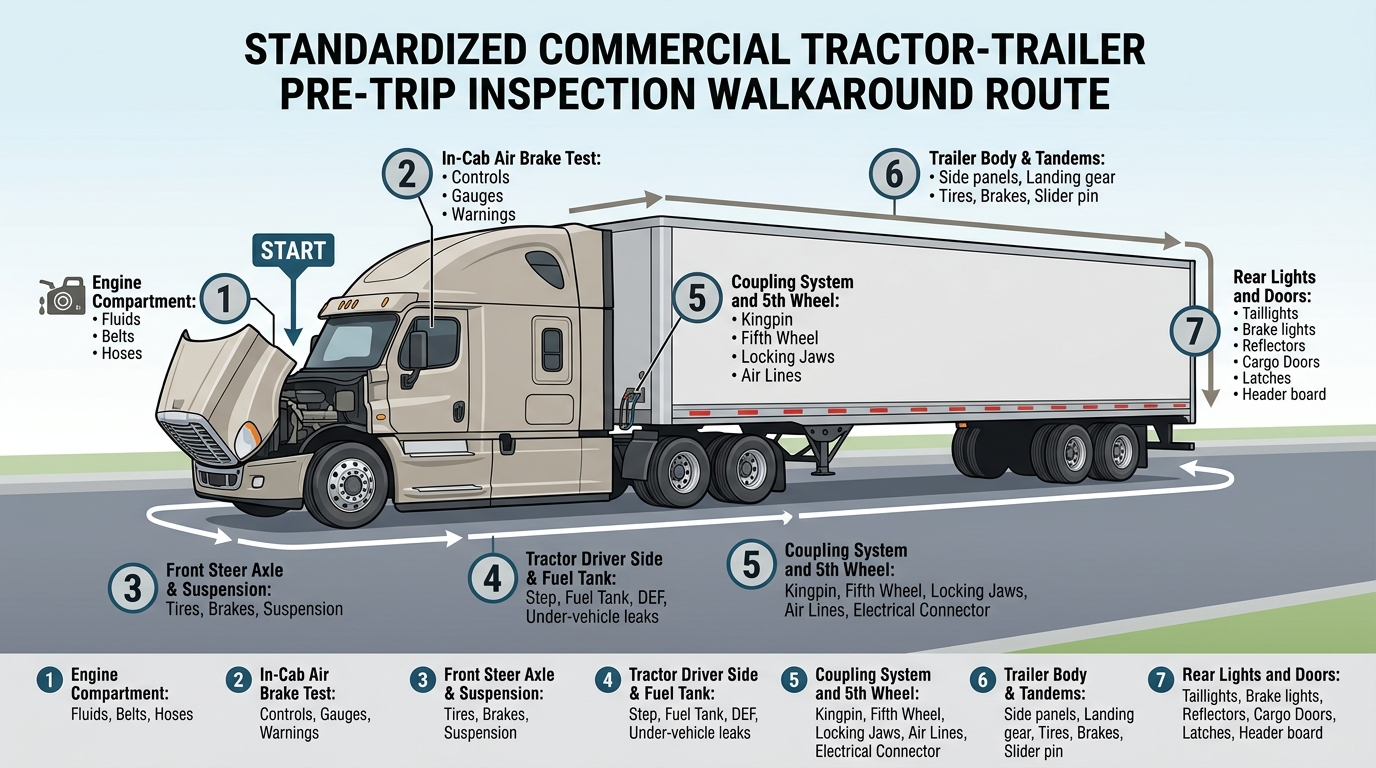
Figure 3.1: Standardized 7-step commercial tractor-trailer pre-trip inspection walkaround route, showing directional flow from engine compartment through in-cab air brake tests to trailer rear doors and lighting.
Ensure Total Vehicle Compliance with Fast Form HVUT 2290 E-Filing
Passing your pre-trip inspection ensures mechanical safety, but keeping your IRS heavy vehicle use tax watermark valid keeps your registration active. File Form HVUT 2290 with Consulics in minutes.
e-File Form HVUT 2290 Now →The 7-Step Pre-Trip Memory Script: Component-by-Component Walkthrough
To pass the state exam and satisfy daily pre-trip mandates under 49 CFR § 396.13, follow this exact verbal script across all seven physical inspection zones:
- Step 1: Engine Compartment (Fluids, Belts & Hoses): Unlatch hood. Check engine oil level (above add mark on dipstick), coolant reservoir (between min and max), power steering fluid, and windshield washer fluid. Inspect serpentine belts (no dry rot, fraying, or cracks; no more than 1/2 to 3/4 inch play at center). Inspect water pump, alternator, and air compressor for secure mounting and no fluid or air leaks.
- Step 2: In-Cab Air Brake & Emergency Equipment Test: Inspect emergency equipment (fire extinguisher UL 5 B:C or 10 B:C charged, 3 reflective triangles, spare fuses). Perform the statutory 4-step air brake test: (1) Applied pressure 1-minute leakage (<4 PSI drop), (2) Low air buzzer/light activation (55–75 PSI), (3) Tractor protection pop-out (20–45 PSI), (4) Compressor build rate (85 to 100 PSI in under 45 seconds).
- Step 3: Front Steer Axle & Suspension: Inspect front steer tires (minimum 4/32” tread, evenly worn, no recaps, properly inflated to 105–110 PSI). Check rims (no welds, cracks, or rust trails indicating loose lug nuts). Hub oil seal (level visible through sight glass, no oil weeping). Leaf springs (none broken, shifted, or missing), U-bolts tight, shock absorber (PMS, no hydraulic fluid weeping). Steering gear box, pitman arm, drag link, tie rod (PMS, castle nuts secured with cotter pins).
- Step 4: Tractor Driver Side & Under-Vehicle: Inspect cab steps (clean, PMS, support weight). Diesel fuel tank and DEF tank (securely strapped, rubber gaskets intact, caps tight, no leaks). Inspect exhaust stack and catalytic aftertreatment (PMS, no black soot trails indicating exhaust gasket leaks). Drive shaft (universal joints tight, safety brackets intact).
- Step 5: Coupling System & 5th Wheel Area: The highest-scrutinized zone. Inspect electric green pigtail and red/blue gladhands (rubber grommets intact, no audible air hiss, safety latches locked). 5th wheel skid plate (properly greased, no space between trailer apron and skid plate). Kingpin and locking jaws (locking jaws closed completely around the shank of the kingpin, not the head). Release arm in locked position with safety latch engaged. Sliding 5th wheel pins fully engaged.
- Step 6: Trailer Body, Landing Gear & Tandems: Inspect trailer front header board (no bulges or loose rivets). Landing gear (fully raised, crank handle stowed in cradle, support frame not bent). Trailer side reflective DOT tape (50% coverage). Trailer tandem slider pins fully engaged. Inspect trailer dual tires (min 2/32” tread, dual spacing clear of debris, valve stem caps present). Brake drums and linings (lining thickness > 1/4 inch, no oil contamination).
- Step 7: Rear Lights, Reflectors & Cargo Doors: Check rear red tail lamps, stop lights, turn signals, and 4-way hazard flashers. Mudflaps (within 8 to 10 inches of pavement, not torn or rubbing tires). Cargo doors (hinges tight, latches locked, seals intact, safety chains fastened).
| Vehicle Zone | Key Components Inspected | Mandatory Verbal Description Script | Critical Roadside Failure Trigger |
|---|---|---|---|
| Engine Bay | Coolant, Oil, Belts, Hoses, Compressor | "Properly mounted and secure, no cracked or frayed belts, no fluid or air leaks." | Fluid dripping on ground; belt play > 3/4 inch; compressor oil leak. |
| Steer Axle | Tires, Hub Seal, Leaf Springs, Tie Rod | "Tires 4/32 inch minimum, no recaps, castle nuts pinned, shock not leaking." | Tread depth under 4/32"; exposed tire cord; broken spring leaf; loose hub. |
| Coupling | Kingpin, Locking Jaws, Skid Plate, Gladhands | "Locking jaws locked around kingpin shank, no gap, air lines secured, no leaks." | Gap between apron and 5th wheel; locking jaws open; missing gladhand seal. |
| In-Cab | Gauges, Horn, Wipers, Air Brake 4-Step | "Buzzer at 60 PSI, valves pop at 30 PSI, air loss under 4 PSI in one minute." | Fails applied leakage test; low-air warning fails to sound. |
| Trailer & Rear | Tandem Pins, Brakes, Lights, Mudflaps | "All 4 slider pins engaged, brake lining over 1/4 inch, all lights clean and working." | Slider pins retracted; brake lining under 1/4"; inoperative brake light. |
Filing HVUT 2290 for Your CDL Commercial Vehicle?
Consulics provides the fastest, most reliable IRS-authorized Form 2290 e-filing for motor carriers. Receive your official stamped Schedule 1 in minutes.
e-File Form HVUT 2290 Online →Related resources
- File Form 2290 online
- How to file Form 2290, step by step
- HVUT and the stamped Schedule 1, explained
- Estimate your tax with the HVUT 2290 calculator
- Check your Form 2290 due date
- Commercial Truck Air Brake System Inspection Guide
- Driver Vehicle Inspection Report (DVIR) Rules
- Entry-Level Driver Training (ELDT) Blueprint
- Commercial Truck Emergency Safety Kit Requirements
- E-File IRS Form 2290 Online
- IRS Stamped Schedule 1 Proof of Payment
- Form 2290 Due Date & Penalty Calculator
- DOT New Entrant Safety Audit Preparation Guide
More Form 2290 and HVUT guides
- Commercial Truck Air Brake System Inspection & 4-Step Leakage Test Guide: FMCSA Compliance & CVSA Standards
- Driver Vehicle Inspection Report (DVIR) Guide: FMCSA 49 CFR § 396.11 Rules, Pre/Post-Trip Mandates & Retention
- FMCSA Entry-Level Driver Training (ELDT) Guide: Theory Curriculum, BTW Testing, and TPR Compliance
- FMCSA Clearinghouse & Random Drug Testing Guide: Pre-Employment, Annual Queries, and Consortiums
- DOT Sleep Apnea Testing & CPAP Rules Guide: Screening Criteria, Compliance Hours, and Medical Card Recertification
- Commercial Truck Accident Scene Guide: 49 CFR § 382.303 Post-Crash Testing & Claim Defense
Ready to file your Form 2290?
IRS-authorized e-filing — get your stamped Schedule 1 in minutes.
e-File Form 2290 Now →This post is general information for motor carriers, not tax or legal advice, and government rules, systems, and fees can change at any time. Confirm anything before you rely on it with the IRS, the FMCSA, or a qualified professional. Consulics does not guarantee its accuracy or currency and accepts no liability for information an agency later changes.