Federal DVIR Mandate: Understanding 49 CFR § 396.11 and Daily Carrier Obligations
Under Title 49 of the Code of Federal Regulations (49 CFR) § 396.11, every commercial motor carrier operating in interstate commerce is legally required to establish a documented, daily inspection reporting mechanism known as the Driver Vehicle Inspection Report (DVIR). While pre-trip walkarounds are performed before dispatch under § 396.13, the statutory DVIR report is executed at the completion of each day's driving work on every power unit and trailing unit operated.
Under the modernized federal rule, if no safety defects or mechanical deficiencies are found during daily operations, passenger-carrying commercial vehicles must still prepare a DVIR, while property-carrying commercial trucks are exempt from filing a written report *if and only if zero defects exist*. However, the moment an operator notices a cracked leaf spring, an air leak, a worn tire, an inoperative turn signal, or a weeping hub seal, a written or electronic DVIR becomes federally mandatory.
Failure to complete, sign, or maintain required DVIR records during roadside DOT compliance audits incurs severe violation points under the FMCSA Vehicle Maintenance BASIC, triggering targeted interventions, safety rating downgrades, and potential civil monetary penalties.
- Daily Post-Trip Execution: The DVIR must be prepared at the conclusion of each duty tour or day's work on the commercial vehicle.
- 11 Mandatory Component Categories: Federal law lists eleven specific mechanical assemblies that must be addressed on every DVIR.
- Three-Signature Compliance Chain: Defect reported by driver → Certified repair sign-off by mechanic → Verification signature by next dispatched driver.
- 3-Month Mandatory Record Retention: Carriers must retain every completed DVIR (along with mechanic repair certifications) for a minimum of three months (90 days) at the principal place of business.
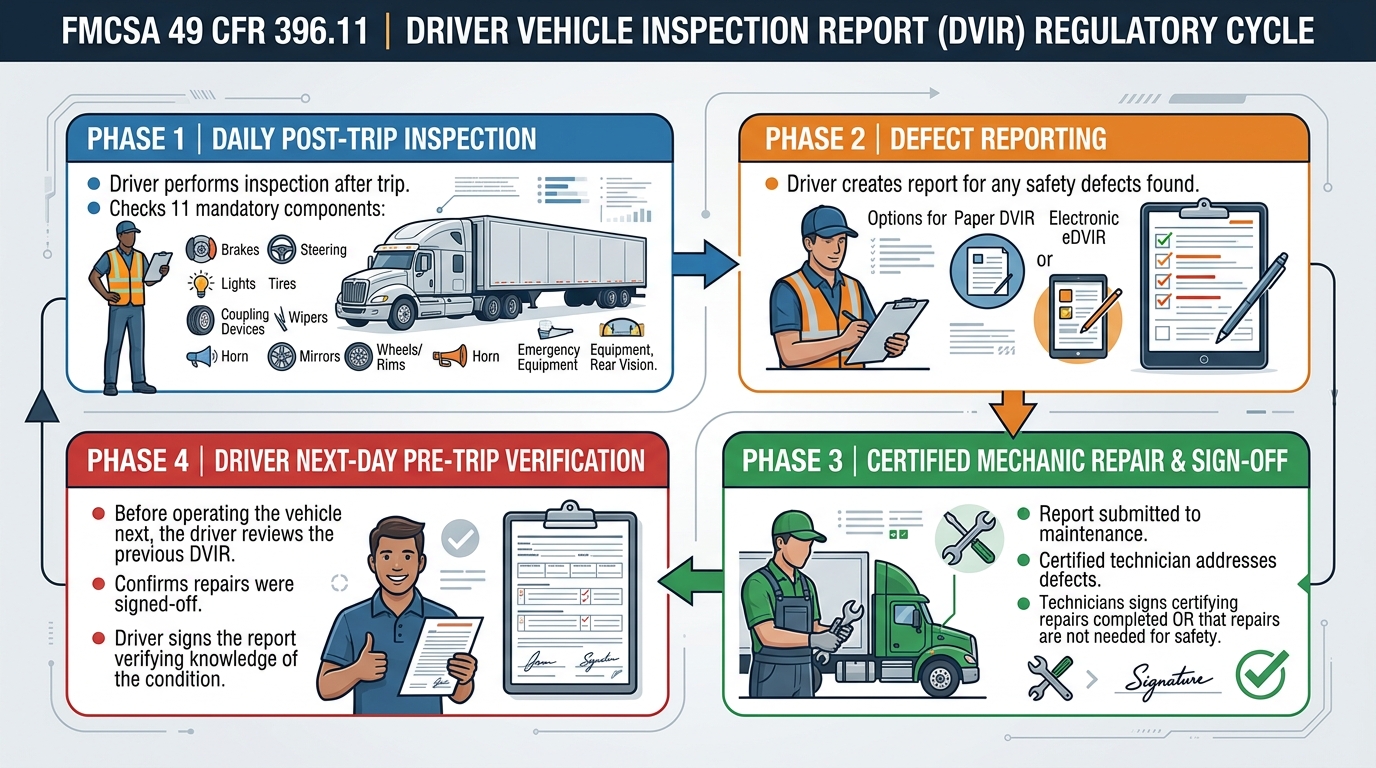
Figure 3.2: The complete 4-phase FMCSA DVIR regulatory cycle: daily post-trip walkaround, defect logging on paper or mobile eDVIR, certified technician repair sign-off, and next-day driver verification.
Ensure Total Fleet Compliance with Form HVUT 2290 E-Filing
Safety audits evaluate mechanical DVIR maintenance alongside federal tax filings. Maintain your IRS Form 2290 stamped Schedule 1 with Consulics instant online filing.
e-File Form HVUT 2290 Now →The 11 Mandatory Mechanical Components Specified in 49 CFR § 396.11(a)(1)
Federal regulations leave no ambiguity regarding what mechanical components must be evaluated on a commercial motor vehicle. Under § 396.11(a)(1), the report must specifically cover the following eleven critical safety items:
| Component Category | Specific Sub-Systems Evaluated | Common Defect Conditions | Safety Risk Level |
|---|---|---|---|
| 1. Service Brakes | Brake chambers, pushrod stroke, brake shoes, drums, air hoses, gladhands | Air leaks, pushrod over-stroke, oil on brake lining, cracked drum | Critical (Immediate OOS risk) |
| 2. Parking (Hand) Brake | Spring brake actuation, cab control valves, tractor protection valve | Valve fails to hold air; spring brake fails to hold vehicle on grade | Critical (Rollaway hazard) |
| 3. Steering Mechanism | Steering gear box, pitman arm, drag link, tie rods, power steering fluid | Steering lash > 2 inches, fluid leaks, missing cotter pins, play in joints | Critical (Loss of directional control) |
| 4. Lighting Devices & Reflectors | Headlights (low/high), brake lights, turn signals, 4-ways, clearance markers | Burnt bulb, cracked red/amber lens, missing reflective tape | High (Nighttime visibility hazard) |
| 5. Tires | Tread depth (4/32" steer, 2/32" drive/trailer), inflation PSI, casing integrity | Sidewall bulges, exposed cord, tread chunking, flat tire | Critical (Blowout hazard) |
| 6. Horn | Electric city horn and pneumatic air horn | Air horn valve seized, electric horn inoperative | Medium (Audible warning failure) |
| 7. Windshield Wipers | Wiper blades, motor operation, washer fluid nozzles | Torn rubber blade, wiper motor failed, washer fluid pump dry | High (Adverse weather visibility loss) |
| 8. Rear Vision Mirrors | Driver side, passenger side, and convex spot mirrors | Cracked glass, loose mounting bracket unable to hold position | High (Blind spot collision risk) |
| 9. Coupling Equipment | 5th wheel, kingpin, locking jaws, safety latch, pintle hooks, safety chains | Slack between apron and 5th wheel, locking jaws worn, cracked frame | Critical (Trailer detachment risk) |
| 10. Wheels and Rims | Steel/aluminum rims, lug nuts, studs, wheel hub oil seals | Cracked rim between bolt holes, rust streaks (loose lugs), leaking hub | Critical (Wheel-off separation hazard) |
| 11. Emergency Equipment | Fire extinguisher, 3 reflective triangles, spare fuses (49 CFR § 393.95) | Discharged extinguisher, missing triangles, blown spare fuses | High (Post-breakdown crash hazard) |
Filing HVUT 2290 for Fleet Vehicles?
Consulics provides automated bulk upload and fleet tax management for IRS Form 2290. Maintain active Schedule 1 records for every power unit in your fleet.
e-File Fleet Form 2290 Online →Related resources
- File Form 2290 online
- How to file Form 2290, step by step
- HVUT and the stamped Schedule 1, explained
- Estimate your tax with the HVUT 2290 calculator
- Check your Form 2290 due date
- Class A CDL Pre-Trip Inspection Memory Script
- Commercial Truck Air Brake System Inspection Guide
- Semi-Truck Preventative Maintenance (PM A-D) Schedule
- DOT New Entrant Safety Audit Preparation Guide
- E-File IRS Form 2290 Online
- IRS Stamped Schedule 1 Proof of Payment
- Form 2290 Due Date & Penalty Calculator
- FMCSA CSA Scores & SMS BASICs Optimization Guide
More Form 2290 and HVUT guides
- Class A CDL Pre-Trip Inspection Checklist & Memory Script: 7-Step Walkaround & In-Cab Testing Guide
- Driver Qualification (DQ) File Guide: FMCSA 49 CFR Part 391 Checklist, MVRs, and Retention
- DOT Physical Blood Pressure Limits Guide: Stages 1-3, Certification Durations, and Passing Protocols
- ELD Personal Conveyance vs Yard Move Guide: FMCSA 49 CFR Part 395 Rules, Audit Traps, and Logging Compliance
- FMCSA Clearinghouse & Random Drug Testing Guide: Pre-Employment, Annual Queries, and Consortiums
- DOT, OSHA & ANSI Truck Emergency Safety Kit & Tools Guide: FMCSA Compliance Requirements
Ready to file your Form 2290?
IRS-authorized e-filing — get your stamped Schedule 1 in minutes.
e-File Form 2290 Now →This post is general information for motor carriers, not tax or legal advice, and government rules, systems, and fees can change at any time. Confirm anything before you rely on it with the IRS, the FMCSA, or a qualified professional. Consulics does not guarantee its accuracy or currency and accepts no liability for information an agency later changes.