The Cost of Highway Detention: Why Uncompensated Waiting Wrecks Carrier Profitability
In commercial trucking, time is literally revenue. Under strict federal Hours of Service (HOS) regulations (49 CFR Part 395), a commercial driver has a hard ceiling of 11 hours of driving time within a 14-hour daily duty window. When a commercial truck sits trapped at a shipper or receiver dock for five, six, or eight hours waiting to be loaded or unloaded, the driver’s 14-hour clock ticks away mercilessly without moving revenue miles.
According to DOT and industry studies, commercial truck driver detention costs the trucking sector an estimated $1.3 billion in lost earnings annually and substantially increases crash risks as fatigued drivers attempt to rush to complete transit schedules after long delays.
To protect carrier economics, standard commercial contracts establish three compensatory mechanisms: Detention Pay (hourly reimbursement for extended dock delays), Layover Pay (daily compensation when loading delays strand a driver overnight), and TONU (Truck Order Not Used) (reimbursement when a booked load is cancelled after the truck has already been dispatched). However, collecting detention from freight brokers requires immaculate evidentiary proof and strict adherence to contract timelines.
- Standard Free Time Window (2 Hours): Industry practice grants the shipper or receiver a 2-hour grace period to load or unload without incurring fees.
- Hourly Detention Billing Range: Market detention billing rates range from $50 to $100 per hour, billed in 15-minute increments after the free time window expires.
- Immaculate BOL Proof Required: Brokers will automatically reject detention claims if the Bill of Lading (BOL) lacks signed, legible in-and-out timestamps from the facility guard shack.
- Regulatory Integration: Efficient schedule management ensures timely quarterly IFTA reporting and annual Form HVUT 2290 tax compliance.
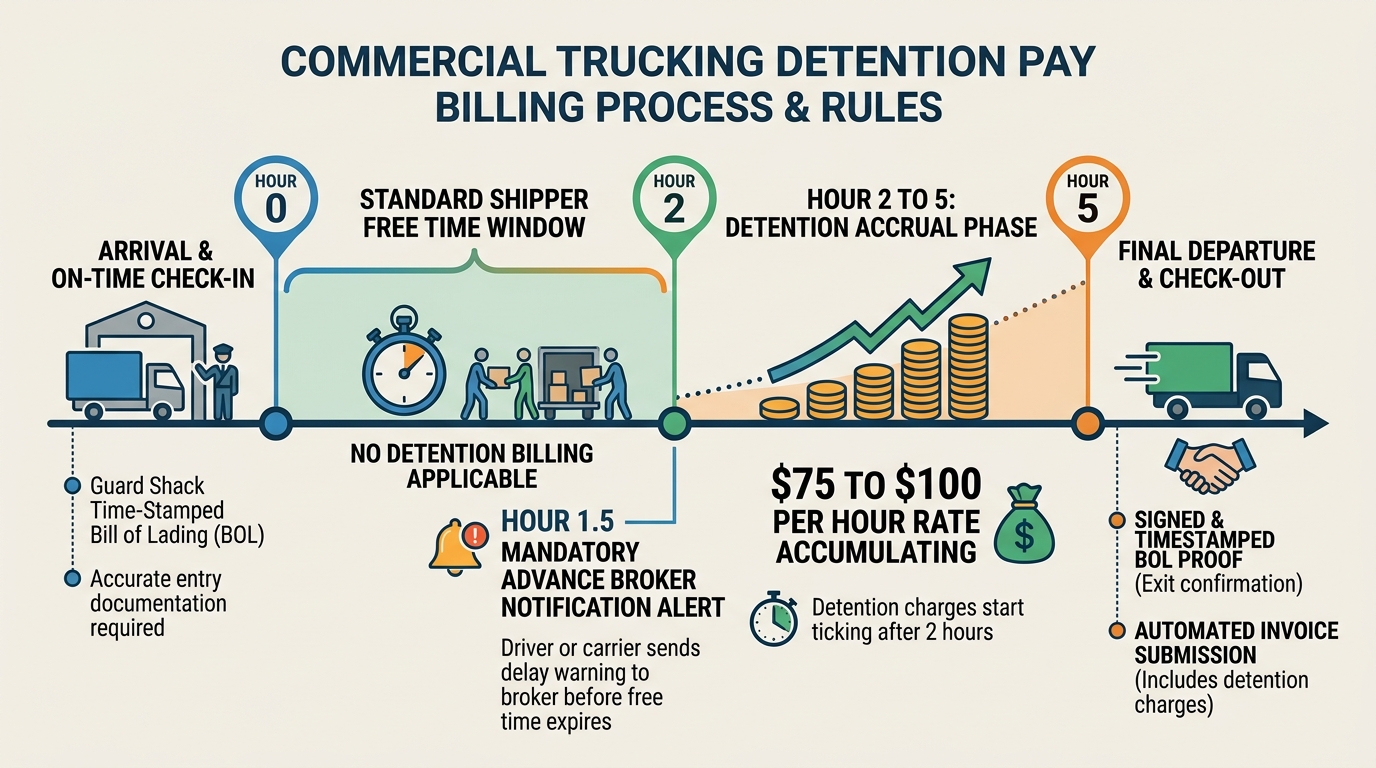
Figure 2.3: Commercial trucking detention billing timeline, showing on-time arrival at Hour 0, 2-hour free time window, mandatory 1.5-hour advance broker notice alert, hourly detention accrual phase, and final departure checkout.
Ensure Commercial Authority Compliance with Form 2290 E-Filing
Don't let facility delays distract you from critical tax deadlines. File Form HVUT 2290 with Consulics and secure your IRS watermarked Schedule 1 in minutes.
e-File Form HVUT 2290 Now →Industry Standard Rate Benchmarks: Detention, Layover & TONU Matrix
Compensation terms vary across freight brokers and shipper contracts. Below are the current North American industry benchmark rates and standard operational requirements for detention, layover, and TONU compensation.
| Compensation Category | Industry Benchmark Rate | Trigger Threshold | Mandatory Documentation Required | Broker Payment Dispute Risk |
|---|---|---|---|---|
| Standard Detention | $50 to $85 per hour (Dry Van) / $65 to $100 (Reefer/Flatbed) | Exceeds 2 hours past scheduled appointment time | Time-stamped BOL with in/out times, signed by guard or dock foreman. | High (Denied if timestamps are missing or driver arrived 1 minute late). |
| Layover Pay | $250 to $400 per day (Dry Van) / $350 to $500 (Reefer/Specialized) | Delay exceeds 6 hours or pushes dispatch into the following calendar day | Written confirmation from broker authorizing layover status; ELD duty logs. | Medium (Requires explicit broker authorization prior to 5:00 PM). |
| TONU (Truck Order Not Used) | $150 to $250 (Dry Van) / $250 to $400 (Specialized / Heavy Haul) | Load cancelled by shipper after driver has been dispatched or arrived on site | Copy of rate confirmation agreement, GPS arrival timestamp, cancellation email. | Low to Medium (Broker must verify driver had not yet loaded cargo). |
| Weekend Layover | $300 to $600 for full weekend | Shipper closed from Friday afternoon until Monday morning | Written contract addendum signed by freight broker. | Medium (Must be negotiated in writing before accepting initial dispatch). |
Filing HVUT 2290 for Heavy Commercial Trucks?
Consulics is the #1 rated IRS-authorized Form 2290 e-file platform. Secure your verified Schedule 1 proof in 5 minutes with free VIN correction support.
Start Your Form 2290 Filing →The 5 Non-Negotiable Rules to Win Detention Pay Claims
Freight brokers receive thousands of detention requests every week and actively look for technical discrepancies to deny claims. Motor carriers that consistently collect 100% of their detention revenue enforce these five procedural rules across their dispatch team:
- Rule 1: Never Be Late to the Appointment (Even by 1 Minute): If your delivery appointment is 08:00 AM and your truck clocks in at 08:01 AM, virtually every broker rate confirmation contract automatically voids all detention eligibility. Arrive 15 to 30 minutes early.
- Rule 2: Send the Mandatory 1.5-Hour Notice Alert: Most broker contracts contain a strict "notice clause" requiring the carrier to alert dispatch at least 30 minutes *before* the 2-hour free time expires (at the 1.5-hour mark). If you wait until hour 3 to notify the broker, detention is denied.
- Rule 3: Physical Signature and Legible In/Out Timestamps: Do not leave the shipper guard shack without physical ink timestamps on the Bill of Lading. Both the "Time In" and "Time Out" must be clearly handwritten or computer-printed, accompanied by the receiver's signature or guard stamp.
- Rule 4: Corroborate with ELD Geofence GPS Records: Export your ELD telematics GPS location report showing the precise geo-stamp when the vehicle entered and exited the customer facility perimeter.
- Rule 5: Submit Updated Rate Confirmation Before Leaving: Request an updated, revised rate confirmation reflecting the detention charges *before* your truck leaves the facility parking lot whenever possible.
Stay Road-Ready with IRS Form HVUT 2290
Complete your heavy highway vehicle tax filing with Consulics. Enjoy fast automated e-filing, transparent pricing, and instant IRS watermarked proof.
e-File HVUT 2290 Online →Related resources
- File Form 2290 online
- How to file Form 2290, step by step
- HVUT and the stamped Schedule 1, explained
- Estimate your tax with the HVUT 2290 calculator
- Check your Form 2290 due date
- Freight Factoring Cash Flow & Fee Guide
- Freight Broker Credit Checks & BMC-84 Bond Claims
- Hours of Service (HOS) Compliance Guide
- Owner-Operator Cost-Per-Mile Budgeting Blueprint
- E-File IRS Form 2290 Online
- IRS Stamped Schedule 1 Proof of Payment
- Form 2290 Due Date & Penalty Calculator
- DOT New Entrant Safety Audit Preparation Guide
More Form 2290 and HVUT guides
- Freight Factoring Guide for Truckers: Recourse vs. Non-Recourse, Hidden Fees, and Cash Flow Optimization
- Rate Confirmation (Rate Con) Guide: Contract Clauses, Hidden Fines, and Binding Addendums
- Spot Market vs Contract Freight Guide: Rate Calculations, Load Board Bidding, and Lane Density
- Freight Broker Credit Checks & BMC-84 Bond Claims Guide: Due Diligence, Payment Protection, and Fraud Prevention
- Semi-Truck Parking Shortage & Reservation Guide: Jason's Law, Travel Plazas, Rest Areas, and Safe Haven Rules
- Refrigerated Reefer Trucking Operations Guide: Continuous vs Start-Stop Modes, Pulping, and FSMA Rules
Ready to file your Form 2290?
IRS-authorized e-filing — get your stamped Schedule 1 in minutes.
e-File Form 2290 Now →This post is general information for motor carriers, not tax or legal advice, and government rules, systems, and fees can change at any time. Confirm anything before you rely on it with the IRS, the FMCSA, or a qualified professional. Consulics does not guarantee its accuracy or currency and accepts no liability for information an agency later changes.