The Commercial Trucking Cash Flow Dilemma: Why Motor Carriers Rely on Factoring
In the commercial freight industry, moving revenue loads is only half the battle; collecting payment in time to fund ongoing operational expenses is the true determinant of carrier survival. An independent owner-operator or small fleet running interstate freight incurs immediate, non-negotiable weekly outlays: diesel fuel, highway tolls, driver compensation, preventative maintenance, insurance premiums, and statutory annual IRS Form HVUT 2290 highway taxes.
Conversely, commercial shippers and freight brokers operate on traditional Net 30, Net 45, or Net 60-day payment cycles. A motor carrier that hauls a $4,500 cross-country dry van or reefer load in the first week of the month often will not receive electronic payment until the middle of the following month. For a growing carrier dispatching three to ten power units, carrying $40,000 to $100,000 in uncollected accounts receivable creates an acute liquidity crisis that can halt dispatches.
To bridge this financial gap, the vast majority of motor carriers utilize freight factoring. Factoring is not an equipment loan; it is the financial sale of outstanding freight invoices (supported by certified Bills of Lading and rate confirmation contracts) to a specialized commercial factoring firm in exchange for immediate capital—typically deposited within 12 to 24 hours of delivery.
- Immediate Liquidity vs. 30-Day Delay: Eliminates the 30- to 60-day broker payment lag, transforming accounts receivable into liquid operating cash within 24 hours.
- Asset-Based Capital: Factoring approval hinges upon the creditworthiness and payment history of the freight broker or shipper paying the invoice, not the motor carrier's personal credit score.
- Back-Office Billing Automation: Factoring companies handle invoice generation, collections, billing dispute resolution, and payment chasing, reducing administrative overhead for carriers.
- Tax Compliance Interconnection: Consistent cash flow ensures motor carriers maintain timely reserve funding for quarterly IFTA fuel taxes and statutory Form 2290 HVUT payments.
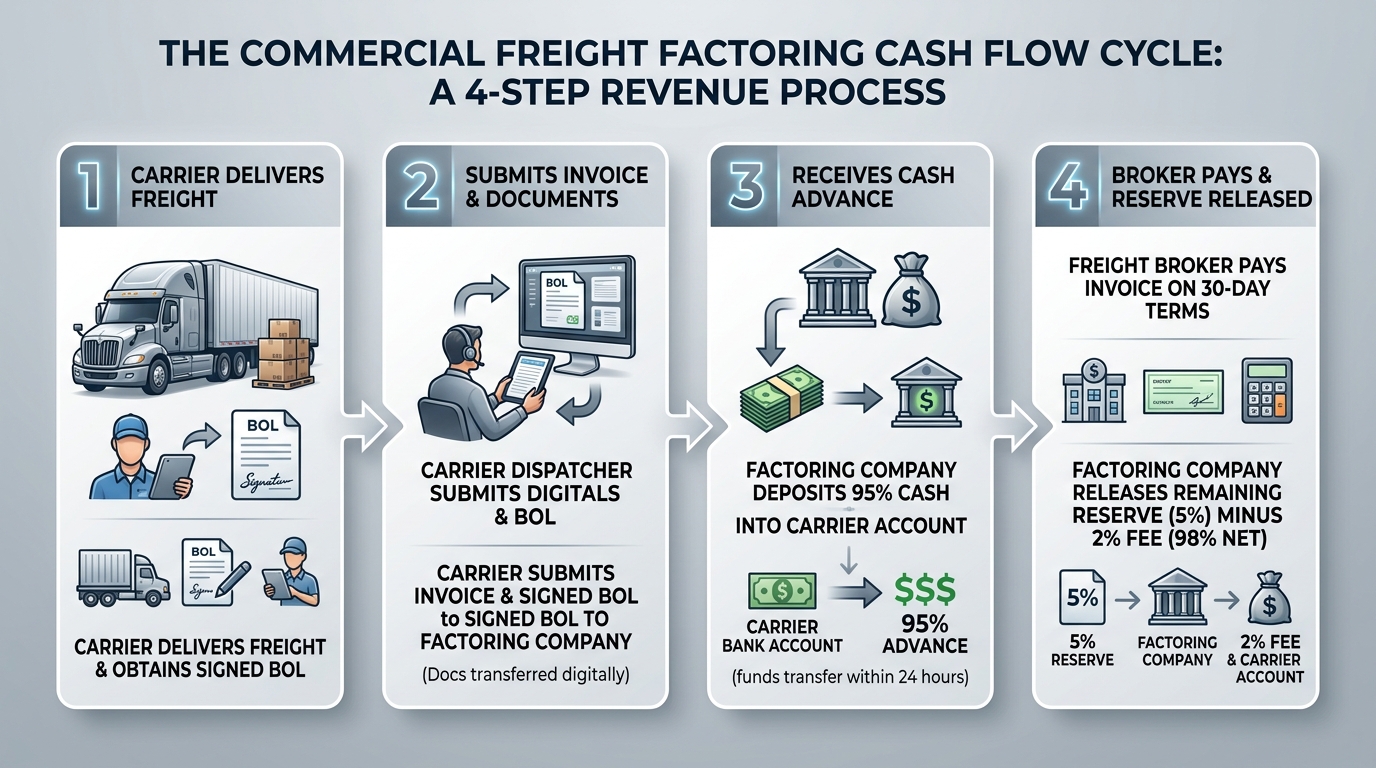
Figure 2.1: The commercial freight factoring revenue workflow: freight delivery with signed BOL, digital invoice submission, 95% immediate cash advance within 24 hours, and final reserve release upon broker payment.
Protect Your Cash Flow & Authority with Rapid Form 2290 E-Filing
Managing receivables is vital, but operating without a valid IRS stamped Schedule 1 will get your apportioned plates cancelled. E-file Form HVUT 2290 with Consulics in minutes.
e-File Form HVUT 2290 Now →Recourse vs. Non-Recourse Factoring: Understanding Credit Risk vs. Dispute Risk
The most critical legal and financial distinction in commercial factoring is the choice between Recourse Factoring and Non-Recourse Factoring. Misunderstanding the fine print of these contracts is among the most costly mistakes made by new motor carriers.
In a Recourse Factoring agreement, the motor carrier ultimately remains financially liable if the debtor (freight broker or shipper) fails to pay the invoice within a specified aging period (typically 60 to 90 days). If the broker defaults or goes bankrupt, the factoring company initiates a chargeback, deducting the advanced capital from the carrier's reserve account or future invoice advances. Because the carrier bears the ultimate credit risk, factoring fees for recourse programs are lower, generally ranging between 1.0% and 2.5%.
In a Non-Recourse Factoring agreement, the factoring firm assumes the financial loss if the freight broker suffers documented insolvency, bankruptcy, or credit default. For this protection, carriers pay higher factoring fees, typically 2.5% to 5.0%. However, carriers must examine the contractual definition of "non-recourse": factoring companies only absorb losses caused by *bona fide credit insolvency*. If the broker withholds payment due to a cargo damage claim, late delivery penalty, or rate dispute, the non-recourse clause does not apply, and the invoice is charged back to the carrier.
| Contract Feature | Recourse Factoring | True Non-Recourse Factoring | Operational Impact on Motor Carrier |
|---|---|---|---|
| Factoring Fee Range | 1.0% to 2.5% of gross invoice | 2.5% to 5.0% of gross invoice | Recourse saves $75–$125 per $5,000 load in direct factoring overhead. |
| Credit Default Liability | Motor Carrier assumes 100% liability | Factoring Company assumes credit loss | Non-recourse protects carrier if approved broker declares Chapter 7/11 bankruptcy. |
| Invoice Dispute Protection | None (Carrier handles disputes) | None (Disputes are excluded) | Neither contract covers freight claims; carrier cargo insurance handles damages. |
| Broker Credit Check Mandate | Recommended by carrier | Mandatory prior to booking load | Under non-recourse, loads booked with unapproved brokers are factored as recourse. |
| Reserve Holdback | 3% to 5% retained until paid | 0% to 5% retained until paid | Some premium non-recourse programs offer 100% advance with zero reserve holdback. |
| Chargeback Period | Typically 60 to 90 days from invoice | No chargeback for credit bankruptcy | Recourse requires active cash reserve buffer to absorb occasional broker payment defaults. |
File Form HVUT 2290 and Secure Stamped Schedule 1 Proof
Factoring companies verify active carrier authority before purchasing invoices. Ensure your Form 2290 tax compliance is verified with Consulics fast IRS e-filing.
Get Stamped Schedule 1 Now →Uncovering Hidden Factoring Contract Traps: Minimums, Aging Fees, and UCC-1 Liens
Factoring sales representatives frequently market headline discount rates like "1.5% flat factoring." However, predatory factoring agreements often conceal complex secondary fee structures that escalate effective factoring costs past 6% to 8% of gross revenue. Before executing an accounts receivable contract, motor carriers must perform strict contractual due diligence.
- Monthly Minimum Volume Penalties: Many contracts require the carrier to factor a minimum monthly revenue volume (e.g., $25,000 or $50,000/month). If freight rates drop or your truck experiences a mechanical breakdown and revenue falls below the minimum, the factoring company assesses penalty surcharges.
- Invoice Aging Surcharges (Tiered Rates): A contract may advertise a 1.5% rate for the first 30 days, but stipulate an additional 0.5% surcharge for every 10 days the invoice remains outstanding past Net 30. If an unorganized broker pays on day 55, your factoring fee doubles.
- ACH & Wire Transfer Transaction Fees: Charging $15 to $35 per same-day ACH wire transfer or fuel card load. Over a month of daily factoring, transfer fees quietly erode hundreds of dollars in operating profit.
- The UCC-1 Blanket Lien Lockup: When you sign a factoring contract, the company files a UCC-1 Financing Statement with your state Secretary of State. This creates a blanket legal lien on *all* current and future accounts receivable. You cannot factor with another firm or obtain traditional bank financing until the factoring company files a formal UCC-3 termination statement.
- Long-Term Contractual Lock-Ins & Termination Fees: Beware of contracts with 12- to 24-month automatic renewal clauses requiring 60-day certified mail notice to exit, paired with early termination buyout fees ranging from $2,500 to $10,000.
| Fee Category | Contractual Clause | Typical Charge Amount | How to Negotiate Out of Contract |
|---|---|---|---|
| Invoice Processing Fee | Administrative handling per load | $3.00 to $10.00 per invoice | Demand zero processing fees; standard discount rate must be all-inclusive. |
| Credit Check Fee | Fee per debtor credit search | $2.00 to $5.00 per search | Require unlimited free online broker credit checks via factoring portal. |
| Same-Day Wire Transfer | Expedited capital disbursement | $25.00 to $45.00 per wire | Utilize standard next-day ACH (typically free) instead of same-day wire. |
| Aging Surcharge | Invoices paid past 30 days | 0.5% per 10-day block | Insist on flat-rate factoring with no tiered aging escalators. |
| Early Termination Fee | Exiting contract before term | $2,500 to $5,000 buyout | Negotiate a month-to-month agreement with 30-day written cancellation notice. |
Maintain Highway Authority with IRS Form 2290 E-Filing
Don't let administrative oversights sideline your trucks. E-file Form HVUT 2290 with Consulics, generate your stamped Schedule 1, and keep your fleet rolling.
e-File Form HVUT 2290 Online →Related resources
- File Form 2290 online
- How to file Form 2290, step by step
- HVUT and the stamped Schedule 1, explained
- Estimate your tax with the HVUT 2290 calculator
- Check your Form 2290 due date
- Commercial Truck Fuel Cards & Fleet Discounts Guide
- Detention Pay, Layover & TONU Billing Guide
- Freight Broker Credit Checks & BMC-84 Bond Claims
- Owner-Operator Cost-Per-Mile Budgeting Blueprint
- Buying vs. Leasing a Semi-Truck Guide
- E-File IRS Form 2290 Online
- IRS Stamped Schedule 1 Proof of Payment
- Form 2290 Due Date & Penalty Calculator
More Form 2290 and HVUT guides
- Detention Pay, Layover & TONU Guide for Truckers: Industry Rates, Billing Rules, and Broker Negotiations
- Rate Confirmation (Rate Con) Guide: Contract Clauses, Hidden Fines, and Binding Addendums
- Freight Broker Credit Checks & BMC-84 Bond Claims Guide: Due Diligence, Payment Protection, and Fraud Prevention
- Deadhead Miles Minimization Guide: Triangular Routing, Backhaul Economics, and Yield Optimization
- Spot Market vs Contract Freight Guide: Rate Calculations, Load Board Bidding, and Lane Density
- Intermodal Drayage & Port Trucking Guide: TWIC Cards, UIIA Agreements, Chassis Inspections, and Demurrage
Ready to file your Form 2290?
IRS-authorized e-filing — get your stamped Schedule 1 in minutes.
e-File Form 2290 Now →This post is general information for motor carriers, not tax or legal advice, and government rules, systems, and fees can change at any time. Confirm anything before you rely on it with the IRS, the FMCSA, or a qualified professional. Consulics does not guarantee its accuracy or currency and accepts no liability for information an agency later changes.