Freight Broker Financial Due Diligence: Why Checking Broker Credit Precedes Loading
In the spot freight market, booking a high-paying load is meaningless if the broker fails to pay the invoice. Thousands of motor carriers haul multi-thousand-dollar loads across the country, only to discover 60 days later that the brokerage has defaulted, revoked its authority, or vanished into thin air.
Before signing a Rate Confirmation contract or dispatching equipment to a shipper, commercial motor carriers must perform rigorous financial due diligence. Unlike shipper contracts where relationships are established over years, spot market transactions require immediate evaluation of the broker’s Days-to-Pay (DTP) metric, credit score, and active legal filings on the FMCSA SAFER (Safety and Fitness Electronic Records) system.
Federal law provides motor carriers with crucial legal protection: under 49 CFR Part 387, every licensed freight broker must maintain a minimum $75,000 BMC-84 Surety Bond (or BMC-85 Trust Fund). If a broker defaults on valid freight charges, the carrier has the statutory right to file a claim directly against that surety bond to collect payment.
- Days-to-Pay (DTP) Benchmark: Reputable freight brokers maintain an average DTP between 21 and 28 days. An average DTP exceeding 40 days is a major financial warning sign.
- $75,000 Statutory Surety Bond: FMCSA mandate requires every property broker to maintain an active BMC-84 bond to protect carriers from non-payment.
- Double Brokering Epidemic: Unauthorized re-brokering and carrier impersonation cost the trucking industry hundreds of millions annually, requiring strict identity verification.
- Carrier Administrative Health: Maintaining impeccable operational records, from signed Bills of Lading to verified Form HVUT 2290 Stamped Schedule 1 proof, reinforces carrier standing during legal disputes.
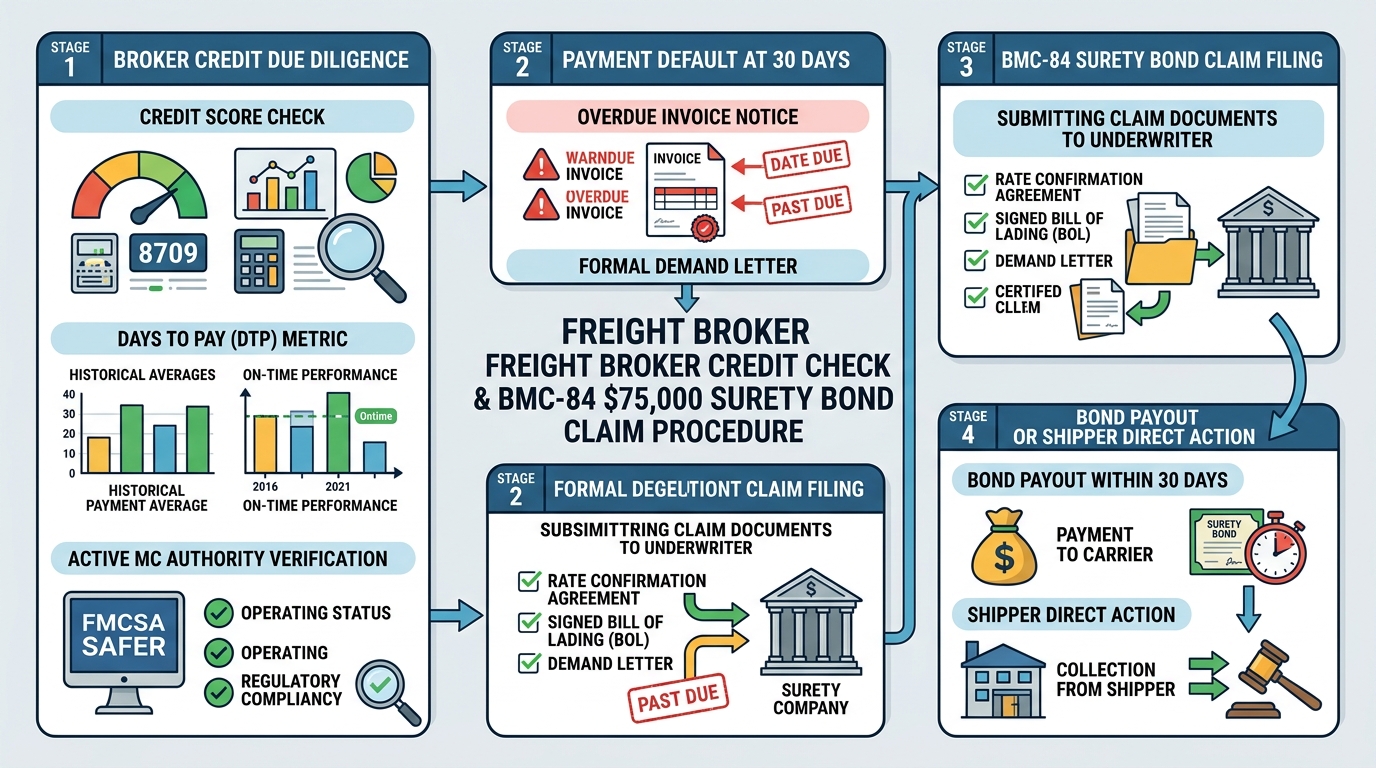
Figure 2.4: Freight broker due diligence and BMC-84 surety bond claim lifecycle, showing credit checking, 30-day default notice, formal claim filing with the surety underwriter, and bond payout arbitration.
Keep Your Motor Carrier Authority Legal with Form 2290 E-Filing
Protect your trucking enterprise against audits and registration holds. File Form HVUT 2290 with Consulics and receive your IRS watermarked Schedule 1 in minutes.
e-File HVUT 2290 Now →How to Read Freight Broker Credit Scores & Days-to-Pay (DTP)
Commercial transportation credit reporting agencies (such as Ansonia, TransCredit, and major load board credit databases) grade freight brokers based on verified payment history. Carriers must understand how to interpret these scores before dispatching drivers.
| Credit Score / Grade | Average Days-to-Pay (DTP) | Financial Health Assessment | Factoring Company Status | Recommended Carrier Action |
|---|---|---|---|---|
| Score: 90–100 (Tier A) | 18 to 25 Days | Impeccable credit; high cash reserves; major national 3PL | Approved with highest advance rates (100% factoring credit line) | Safe to book; prompt payment standard. |
| Score: 75–89 (Tier B) | 26 to 34 Days | Stable financial standing; occasional administrative delay | Approved with standard factoring advance rates | Accept loads; monitor invoice aging closely at 30 days. |
| Score: 60–74 (Tier C) | 35 to 45 Days | Elevated credit risk; potential cash flow strain or slow billing | Restricted credit limit; may require recourse agreement | Exercise caution; limit exposure to 1 single load at a time. |
| Score: Under 60 (Tier D) | Exceeds 45 Days | Severe credit default risk; multiple carrier payment complaints | Factoring company placed on "Do Not Haul" blackout list | DO NOT BOOK; high risk of non-payment and bond exhaustion. |
Verify Your Form 2290 Heavy Vehicle Tax Compliance
State DMVs require verified Schedule 1 proof before issuing commercial tags. Consulics makes Form 2290 filing quick, accurate, and completely online.
File Form HVUT 2290 Online →Step-by-Step Procedure: How to File a Claim on a Freight Broker’s $75,000 BMC-84 Bond
When a freight broker fails to pay an invoice past 30 to 45 days and stops responding to billing inquiries, motor carriers must act swiftly. Because multiple carriers may be unpaid simultaneously, the first carriers to file claims against the finite $75,000 bond pool are the ones who get paid in full before the bond is exhausted.
- Step 1: Locate the Broker's Bond Company on FMCSA SAFER: Go to the public FMCSA SAFER Licensing & Insurance portal (li-public.fmcsa.dot.gov). Enter the broker's MC or USDOT number. Navigate to the "Active/Pending Insurance" tab and identify the exact name, policy number, address, and telephone number of the BMC-84 Surety Bond Company.
- Step 2: Issue a Formal Final Demand Letter: Send a certified formal Demand Letter giving the broker 5 business days to remit full payment before a bond claim is lodged. Include the invoice number, load date, origin/destination, and total amount due.
- Step 3: Compile Complete Evidentiary Claim Package: Assemble the three critical documents: (1) The signed Rate Confirmation Agreement, (2) The clean, legible Bill of Lading (BOL) signed by the consignee proving successful delivery, and (3) The unpaid commercial invoice.
- Step 4: Formally Submit Claim to Surety Underwriter: Contact the bond company's claims department and submit the claim package via certified mail or secure claims portal. The surety will assign a formal claim number.
- Step 5: The 30-Day Surety Investigation Window: Federal law gives the surety company 30 days to investigate. They will contact the broker for rebuttal. If the broker cannot prove payment or valid cargo dispute, the surety company issues a check directly to the motor carrier.
- Step 6: Shipper Direct Liability (The Ultimate Leverage): If the broker's bond is exhausted or cancelled, federal precedent under the legal doctrine of primary carriage liability allows the carrier to demand payment directly from the original shipper who contracted the freight, provided the carrier did not sign away their rights under Section 7 of the Bill of Lading.
Choose the #1 Rated Form HVUT 2290 E-File Provider
Consulics delivers fast, reliable, IRS-authorized Form 2290 e-filing for motor carriers nationwide. Get your stamped Schedule 1 in minutes.
e-File Form HVUT 2290 Now →Related resources
- File Form 2290 online
- How to file Form 2290, step by step
- HVUT and the stamped Schedule 1, explained
- Estimate your tax with the HVUT 2290 calculator
- Check your Form 2290 due date
- Freight Factoring Cash Flow & Fee Guide
- Detention Pay, Layover & TONU Billing Guide
- Owner-Operator Cost-Per-Mile Budgeting Blueprint
- Commercial Truck Insurance & FMCSA Filings Guide
- E-File IRS Form 2290 Online
- IRS Stamped Schedule 1 Proof of Payment
- Form 2290 Due Date & Penalty Calculator
- DOT New Entrant Safety Audit Preparation Guide
More Form 2290 and HVUT guides
- Detention Pay, Layover & TONU Guide for Truckers: Industry Rates, Billing Rules, and Broker Negotiations
- Freight Factoring Guide for Truckers: Recourse vs. Non-Recourse, Hidden Fees, and Cash Flow Optimization
- Refrigerated Reefer Trucking Operations Guide: Continuous vs Start-Stop Modes, Pulping, and FSMA Rules
- Rate Confirmation (Rate Con) Guide: Contract Clauses, Hidden Fines, and Binding Addendums
- EFW, EFTPS, Card, or Check: Choosing How to Pay Your HVUT
- Semi-Truck Financing Guide for New Authorities: Down Payments, Credit Tiers, and Commercial Lending
Ready to file your Form 2290?
IRS-authorized e-filing — get your stamped Schedule 1 in minutes.
e-File Form 2290 Now →This post is general information for motor carriers, not tax or legal advice, and government rules, systems, and fees can change at any time. Confirm anything before you rely on it with the IRS, the FMCSA, or a qualified professional. Consulics does not guarantee its accuracy or currency and accepts no liability for information an agency later changes.