Diesel Fuel Economics: Why Fuel Cards Are the #1 Profit Lever for Motor Carriers
In commercial trucking, diesel fuel represents the single largest variable operating expense, consistently consuming 30% to 40% of total revenue per mile. A typical long-haul Class 8 tractor traveling 100,000 to 120,000 miles per year at an average of 6.5 miles per gallon burns between 15,000 and 18,500 gallons of ultra-low sulfur diesel annually.
At fluctuating diesel prices, paying standard pump retail prices with a consumer credit card or debit card costs motor carriers thousands of dollars in unnecessary expense. Specialized commercial fleet fuel cards provide motor carriers with access to institutional wholesale buying power, delivering substantial per-gallon discounts ranging from 30¢ to over 80¢ per gallon at nationwide travel plaza networks.
Beyond direct price discounts, modern commercial fuel card systems serve as sophisticated fleet management platforms. They enforce granular pump security controls, generate automated transaction records that integrate directly with International Fuel Tax Agreement (IFTA) quarterly reporting, and eliminate the administrative nightmare of organizing physical paper fuel receipts.
- Institutional Volume Pricing: Aggregates purchasing volume across thousands of independent trucks to negotiate wholesale pricing with major travel center chains.
- Substantial Operating Savings: A 50¢ per-gallon discount on 16,000 annual gallons yields $8,000 in direct net profit savings per power unit each year.
- Automated IFTA Fuel Tax Sync: Digitally records transaction location, jurisdiction, date, gallons, and state fuel taxes paid, feeding quarterly tax engines.
- Carrier Compliance Synchronization: Financial fuel savings directly bolster operating reserves needed for mandatory IRS Form 2290 Heavy Highway Vehicle Use Tax annual filings.
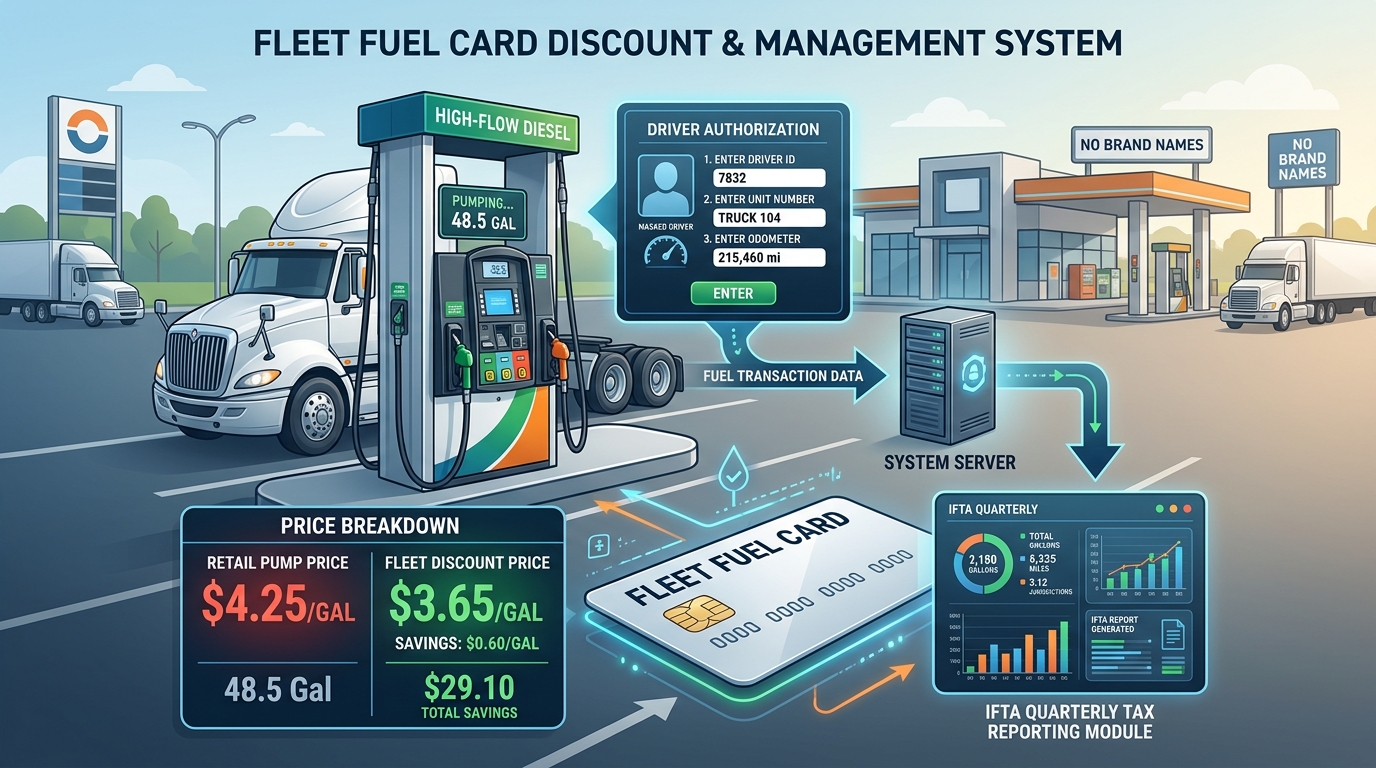
Figure 2.2: Commercial fleet fuel card system workflow, demonstrating driver authorization prompts, cost-plus price breakdown ($4.25 retail vs $3.65 fleet discount), and automated transaction data sync into IFTA quarterly tax reporting.
File Form HVUT 2290 to Keep Your Fleet Road-Legal
Fuel savings keep your trucks rolling, and an active IRS stamped Schedule 1 keeps your apportioned tags valid. File Form HVUT 2290 with Consulics in 5 minutes.
e-File Form HVUT 2290 Now →Cost-Plus vs. Retail-Minus Pricing: Decoding Fuel Card Discount Models
Not all fuel card discount structures operate under the same pricing algorithm. Fleet fuel card providers negotiate discount programs using two primary mechanisms: Retail-Minus pricing and Cost-Plus pricing. Understanding the mathematical difference determines whether your discount expands or shrinks when wholesale oil markets swing.
Under a Retail-Minus pricing model, the fuel card company negotiates a set discount off the posted street price at the pump (e.g., 10¢ or 15¢ off the posted pump price). While simple to calculate, retail prices at major highway interstate exits are heavily inflated. A 15¢ discount off a $4.40 retail price still results in an effective fuel cost of $4.25/gallon.
Under a Cost-Plus pricing model, the fuel price is disconnected from the posted retail board entirely. Instead, the price is pegged to the daily OPIS (Oil Price Information Service) wholesale terminal rack price in that geographic region, plus a negotiated markup (typically cost plus 1¢ to 5¢ per gallon) plus state and federal road taxes. In highway markets where retail pump markups are extreme, cost-plus pricing frequently delivers massive discounts of 50¢ to 90¢ per gallon below posted street prices.
| Pricing Component | Retail Pump Price (Standard) | Retail-Minus Program (15¢ Off) | Cost-Plus Program (Wholesale Rack) |
|---|---|---|---|
| Wholesale Terminal Rack Base | Market Price | Market Price | $2.95 per gallon |
| Federal & State Fuel Taxes | Included in pump price | Included in pump price | $0.54 per gallon (varies by state) |
| Truck Stop Retail Markup | +$0.90 per gallon | +$0.90 per gallon | N/A (Bypassed) |
| Fuel Card Program Fee / Markup | $0.00 | $0.00 | +$0.04 per gallon |
| Posted Retail Board Price | $4.39 per gallon | $4.39 per gallon | $4.39 per gallon (Ignored) |
| Applied Program Discount | $0.00 | -$0.15 per gallon | -$0.86 per gallon (Effective savings) |
| Final Billed Cost Per Gallon | $4.39 / gal | $4.24 / gal | $3.53 / gal |
| Total Cost for 100 Gallons | $439.00 | $424.00 | $353.00 (Saves $86.00 per fill) |
Calculate Your Form 2290 HVUT Tax Liability
Use Consulics free Heavy Vehicle Use Tax calculator to determine your vehicle's exact tax bracket based on taxable gross weight and first used month.
Calculate Form HVUT 2290 Tax →Pump Fraud Protection, Driver Security Controls & Telematics Integration
Commercial fuel theft is a multi-million-dollar threat facing motor carriers. Skimmers installed on truck stop dispensers, stolen physical cards, and unauthorized personal vehicle fill-ups can quickly drain carrier operating capital. Commercial fuel cards integrate advanced financial security parameters at the dispenser:
- Mandatory Two-Factor Prompting: The pump will not dispense diesel until the driver inputs a designated Driver ID / PIN and current tractor Unit Number.
- Odometer Validation & MPG Auditing: Drivers must enter the exact tractor odometer reading. Discrepancies between miles traveled and fuel purchased trigger automated alerts for fuel siphoning or unauthorized secondary vehicle fills.
- Product Type & Volume Hard Limits: Cards can be restricted strictly to "Diesel Fuel Only" and "DEF Only", completely blocking transactions for convenience store retail merchandise, tobacco, or unleaded gasoline.
- GPS Geofence Match: Advanced fuel card systems cross-reference the tractor's ELD telematics GPS location with the fuel station pump terminal. If the card is swiped at a truck stop where the tractor is not physically located, the transaction is instantly declined.
Need IRS Form 2290 Stamped Schedule 1 for Fleet Registration?
Consulics is the leading IRS-authorized e-file service for owner-operators and motor carriers nationwide. Secure your official watermarked Schedule 1 in minutes.
e-File Form HVUT 2290 Now →Related resources
- File Form 2290 online
- How to file Form 2290, step by step
- HVUT and the stamped Schedule 1, explained
- Estimate your tax with the HVUT 2290 calculator
- Check your Form 2290 due date
- Freight Factoring Cash Flow & Fee Guide
- Owner-Operator Cost-Per-Mile Budgeting Blueprint
- Semi-Truck Preventative Maintenance Schedules
- IFTA Fuel Tax Reporting Guide
- E-File IRS Form 2290 Online
- IRS Stamped Schedule 1 Proof of Payment
- Form 2290 Due Date & Penalty Calculator
- Commercial Truck Brands, Models & Engines Guide
More Form 2290 and HVUT guides
- Commercial Truck Toll Management Guide: Transponder Consolidation, Discount Tiers, and Violations
- Owner-Operator Operating Budget & Cost Per Mile (CPM): Complete Financial Blueprint for Independent Truckers
- Commercial Truck Winter Driving & Tire Chaining Laws Guide: State-by-State Regulations, Chain Types, and Fuel Anti-Gel
- DOT Sleep Apnea Testing & CPAP Rules Guide: Screening Criteria, Compliance Hours, and Medical Card Recertification
- DOT Physical Blood Pressure Limits Guide: Stages 1-3, Certification Durations, and Passing Protocols
- Intermodal Drayage & Port Trucking Guide: TWIC Cards, UIIA Agreements, Chassis Inspections, and Demurrage
Ready to file your Form 2290?
IRS-authorized e-filing — get your stamped Schedule 1 in minutes.
e-File Form 2290 Now →This post is general information for motor carriers, not tax or legal advice, and government rules, systems, and fees can change at any time. Confirm anything before you rely on it with the IRS, the FMCSA, or a qualified professional. Consulics does not guarantee its accuracy or currency and accepts no liability for information an agency later changes.